Saturday, May 24, 2014

MAY 24 = The Reds Play Baseball's First Nightgame


“Night baseball went over with a bang in Cincinnati last night when the first major league game ever played under the floodlights was won by the Reds over the Phillies by the count of 2 – 1 after a beautifully played contest.

With more than 20,000 fans in attendance, the two teams put on a combat which was one of the highlights of the early season. Unaffected by the artificial illumination which covered the field in a manner perfectly satisfactory to the athletes, both teams played errorless baseball, each executing some really brilliant plays.”


This was the news that greeted the fans of professional baseball’s oldest franchise, the Cincinnati Reds in their morning paper, the Cincinnati Enquirer on May 25. This was to report to them the events of the night before, today’s date, May 24 in 1935 when the first night game in professional baseball’s history was played at Crosley Field, home of the Cincinnati Reds against the Philadelphia Phillies. The Reds won the game 2 – 1.

The Minor Leagues Point the Way to Games Under the Stars...

Baseball’s first night game ever had actually taken place over five years before, on May 2, 1930. This was when two minor league teams squared off with the Wichita team being hosted by Des Moines Iowa for a Western League match-up. The idea had indeed been a true commercial success with a crowd of 12,000 fans in attendance during a period when Des Moines had been drawing barely 600 fans per-game. It was the time of the Great Depression in America, and minor league clubs were regularly falling by the wayside. The always resourceful and innovative owners of these clubs found in night games a way to bring in scarce fan dollars, as the idea caught on.

But the major league clubs were feeling the pinch as well. The major league owners were a more conservative bunch than their minor-league counterparts. But the owner of MY TEAM – the Cincinnati Reds, Powell Crosley (above, right) was a born innovator, and it didn’t take him long to catch on to this idea. This first big league night game drew over 20,000 fans, who stood by as President Roosevelt symbolically switched on the lights from Washington, D.C. To make good on their new evening fan base, the Reds played at least one night game that year against every National League team; a total of eight such games. And despite having a less than stellar record of 68-85, paid attendance went 117 percent during those games.

A Fascinating Slice of Life in the 1930's:

The account of this first evening game in baseball history, as written by James T. Golden Jr. for the readers of the Cincinnati Enquirer is an engaging look not only at the event itself, but of a vanished time in our history. So I will let the paper do the talking:

“Fandom Gay At First Night Game; High Ball Is Like A Pearl On Velvet


By James T. Golden Jr.

The bands played, Pres. Roosevelt turned on the lights, everybody said “Oh!” in a highly pleased way, Chlozza busted a fast one out towards Cassiopeia’s Chair – and 20,422 fans got fandom’s first introduction to night baseball in the big leagues.

Whether Cassiopeia was leaning down from her constellation to watch the Redlegs and the Phillies wasn’t known, nor was it known whether she could have seen through the light clouds that commenced to drift across from over left field at about the end of the second inning, seeming to stay at about the height of the encircling lights and never dropping below them.

All that the fans cared about was that the visibility was plenty good from the stands and the bleachers, that the field showed up in a more uniform light, green and tan than it does in daytime. It was as brilliant with the trim little white figures running about it, as a new baseball game board in the window of the corner drugstore.

What clouds there were were so thin that the ball, when it flew high, shone through them like a bald head in a steam room. And when there was no mist, the sphere stood out against the sky like a pearl against dark velvet.

The great batteries of lights never seemed to bother either the spectators or the boys on the field. Big and bright as they were, one could look directly into them without winking an eye.

For once the fans in the bleachers were as cool as the spectators in the stands -- maybe a little cooler because the spring month of 1935 annals of the year as “Nippy May” wasn’t much warmer last night than she had been. There were enough overcoats and blankets in evidence to supply a football crowd, but the crispness of the air just reminded everybody that Crosley Field is going to be a swell place to go for amusement on hot summer nights.


The beautiful sex was well repre- sented (Pres- ident Roos- evelt might have been gratified to note the prepon- derance of soprano “Oh’s” that greeted his successful long distance light-turning-oning). But the stands were packed with thousands of the strong , silent sex (which is really sort of weak and very vociferous at a baseball game) – from callow youths accustomed to burning the midnight oil to elderly gentlemen who used to sit in the boiling sun and root for Ty Cobb, and then go home and go to bed with the chickens, but who now elect to stay up with the bats and yell for Billy Myers. 

Charles Rieckel, whose hundredth birthday is coming with October, who hasn’t missed an opener for 35 years since he was a mere youth of 65, and wo can’t remember missing an outstanding game since the 80’s made a special trip up to Cincinnati from his home in Cynthiana, Ky. To see something new under the sun or rather under the moon.

Most of the old timers at the game agreed last night that big-league baseball under Mr. Crosley’s $50,000 worth of illuminating equipment is quite a bit different from playing checkers under a coal oil lamp, and that it certainly has its points – especially when the Red stockings turn in a winner as they did last night."


Photos - Above left, Reds pitcher Paul Derringer. Above right, Reds' catcher, Gilly Campbell #19 and the Reds' first baseman, Billy Sullivan #4.

READERS!! If you would like to comment on this, or any "Today in History" posting, I would love to hear from you!!  You can either sign up to be a member of this blog and post a comment in the space provided below, or you can simply e-mail me directly at:  krustybassist@gmail.com  I seem to be getting hits on this site all over the world, so please do write and let me know how you like what I'm writing (or not!)!!


Sources:

"The Cincinnati Enquirer", May 25, 1935

http://www.crosley-field.com/FNG/index.html

+ 97.
+ 95.
+122.

Friday, May 23, 2014

MAY 23 = Bonnie & Clyde Are Killed


"If they try to act like citizens
And rent them a nice little flat,
About the third night
They're invited to fight By a sub-gun's rat-tat-tat.

They don't think they're too tough or desperate,_
They know that the law always wins;_
They've been shot at before,_
But they do not ignore_
That death is the wages of sin.

Some day they'll go down together;_
And they'll bury them side by side;_
To few it'll be grief_ To the law a relief_ But it's death for Bonnie and Clyde."


These are the final stanzas of a poem written by Bonnie Parker, likely in April of 1934. It could be called prophetic, for on today’s date, May 23 in 1934, the famous fugitive outlaw team of “Bonnie and Clyde” – Bonnie Parker and Clyde Barrow were gunned own and killed in a police ambush outside of Arcadia, Louisiana.

Bonnie and Clyde Meet, and Mate

Bonnie Parker was just 19 years old and was (Above: Bonnie & Clyde/Beatty & Dunaway) visiting her husband in a jail in Texas, when she met Clyde Barrrow, 21 who was serving time in the same jail for burglary. Bonnie’s husband had been her high school sweetheart, but by 1932, the marriage was over in all but name. Neither criminal has left a record of what passed between them at this initial meeting, but it must have made a significant impression on Bonnie. Because forgetting about her husband altogether, she soon after taped a gun to her shapely thigh, and smuggled it into the prison to help him escape. Barrow did indeed make his getaway, but was soon caught in Ohio and returned to prison in Texas. However, a personal appeal to the Governor of Texas from Clyde’s mother got him out of the can in 1932. And he disliked incarceration enough that he vowed never to return to it again.

The Crime Spree of Bonnie and Clyde

It was a short time later that the two reunited and went on to their crime partnership. Clyde went on a spree of robbery, while Bonnie was apprehended in an auto theft, for which she was sentenced to a three-month stint in jail. But Clyde couldn’t keep still and wound
up fatally shooting Sheriff Eugene C. Moore and his deputy while attending a barn dance in Stringtown, Oklahoma on August 5.      Throughout the autumn of 1932, the crime duo whiled away their time in a string of nickel and dime robberies covering both Texas and Oklahoma, and it was during the commission of one these penny-ante felonies that they picked up one W.D. Jones (left), a gas station attendant, and incorporated him into their felonious spree. And soon after this, they recruited Clyde’s brother Buck, who had recently been pardoned by the Texas Governor, Ma Ferguson.

"Robin Hood"? Well, Not Exactly....

For reasons likely having to do with the odd pairing of this boy/girl team, and the “Robin Hood” image that they, and many such outlaws as John Dillinger cultivated, the newspapers and magazines of that time took a kind of liking to the pair. And Arthur Penn’s 1967 film “Bonnie and Clyde” gave the two a sort of youth rebellion feel. But
Robin Hood they were not. Nor were they equals. Clyde Barrow was in fact a confirmed criminal long before he met Bonnie, and far from being so careful not to harm bystanders, which Dillinger was, the two sprayed bullets in every direction carelessly killing anyone who stood nearby in pursuit of mostly small-time loot. And he clearly called the shots (so to speak). And far from being so tall and statuesque as Faye Dunaway, the real Bonnie Parker, while certainly more appealing than say, Baby Face Nelson, was barely four foot ten,
and weighed about 90 pounds. Miley Cyrus, who was reportedly up for the role of Bonnie Parker in an upcoming mini-series based on the famous crime duo looks much closer to the size, height and weight of the actual Bonnie (see photos below), but it was (very sadly) not to be. I don't know why it didn't happen... perhaps you Miley fans out there can write in and fill us all in on that.. I would certainly like to know.  That would have been an interesting bit of casting wouldn't it?  Oh, well....

The Law Catches Up With Bonnie and Clyde

But time and luck were running out on these bandits. Early in 1934, they just managed to escape death in a trap that had been set for them in Missouri, which left two policemen dead. Worse was the loss of Clyde’s brother Buck who was fatally wounded, and Buck's wife
Blanche who was also wounded and captured as well. This culminated in today’s ending for the two in which Texas Ranger Frank Hamer (left) successfully caught up with them after having been on their trail for over three months. Hamer, along with a posse of lawmen from Texas and Louisiana lay in wait for Bonnie and Clyde to drive by, concealed in the bushes. and when they did, the group unloosed a two minute hail of bullets. A total of 167 of these bullets managed to find the auto in which the robbers had been driving, and put a violent end to their short, but violent career. And contrary to the poem’s ending, while both were buried in Dallas, Bonnie’s mother would not allow them to be buried side by side. Bonnie was buried in Crown Hill Cemetery, and Clyde was interred next to his late brother, Buck at Western Heights Cemetary.


READERS!! If you would like to comment on this, or any "Today in History" posting, I would love to hear from you!!  You can either sign up to be a member of this blog and post a comment in the space provided below, or you can simply e-mail me directly at:  krustybassist@gmail.com  I seem to be getting hits on this site all over the world, so please do write and let me know how you like what I'm writing (or not!)!!

Sources:

by Mark C. Carnes, Henry Holt & Co. Inc. New York, 1998.


http://en.wikipedia.org/wiki/Bonnie_and_Clyde

http://history1900s.about.com/od/1930s/qt/bonniepoem.htm

+ 147.
+ 9312
+ 1052

Thursday, May 22, 2014

SPECIAL = Stolen Gardner Works Sighted


The following news article has been copied directly from Fox News at the following web address:
http://www.foxnews.com/us/2014/05/22/confirmed-sightings-missing-boston-artwork-in-decades-old-500m-heist/   It is presented here as a news item of interest to "Today in History" readers who may be interested in this: the most stunning art theft in history which remains as yet, unsolved....


{Above: "Chez Tortoni" by Manet, one of the works stolen from the Gardner Museum}

The FBI agent in charge of the investigation into the theft of $500 million worth of masterpieces from a Boston museum nearly a quarter century ago says the bureau has confirmed sightings of the missing artwork from credible sources.

MyFoxBoston.com first reported that FBI Special Agent Geoff Kelly, who lead the international investigation for more than 10 years, says the trail for the missing artwork has not grown cold.

"We believe that over certain periods of time, this artwork has been spotted," Kelly told the station. "There have been sightings of it, confirmed sightings."

He identified three persons of interest, two of whom died, and all with reported links to organized crime. The one surviving person, Robert Gentile, 78, has denied any knowledge of the missing work, the report said.

The heist is something out of a Hollywood thriller. It was the morning of March 18, 1990, and two men disguised as police officers arrived at the Isabella Gardner Museum. They claimed to be responding to a report of a disturbance.

The suspects, described as white men in their 30s, took advantage of the inexperienced security guards and tied them up. In 81 minutes, the suspects, who police say had "inside knowledge" of the museum's surveillance system, exited with 13 pieces of art, including Rembrandt's "The Storm on the Sea of Galilee" (below) and Vermeer's "The Concert" (above). It was considered the most expensive collection of stolen artwork in history.

Though the thieves clearly planned out the heist, authorities called them inexperienced art thieves, resorting to box cutters to remove paintings from frames.

Kelly said in the late 1990s, two FBI informants told law enforcement that Carmello Merlino was preparing to return Rembrandt's “The Storm on the Sea of Galilee,” in an effort to collect the reward.

However, Merlino and his crew were soon arrested in an aborted armored car heist and the painting was never returned, MyFoxBoston.com reported. Kelly suspects one of the persons of interest, the late Robert Guarente, somehow passed control of the stolen Gardner artwork to Gentile, the report says

But a 2012 search of Gentile’s home in Manchester, Conn., yielded no sign of the stolen artwork. Gentile, through his lawyer, denied having any connection to the Gardner art heist or with moving the artwork after the fact.

Authorities have said the artwork is likely stashed away and is of little value to the thieves because "there is no market for it."

Another case of great magnitude occurred in France in May 2010, when a masked man broke into Paris' Musée d'Art Moderne overnight and left with five famous works, including Picasso’s "Le Pigeon aux Petits Pois" and Matisse's "La Pastorale." French authorities are reportedly still searching for the suspect, who they believe acted alone, and have said the treasured artworks cannot be sold due to their very fame.

{Above: "Three Mounted Jockies" by Degas; also stolen from the Gardner Museum on 3/18/90.}

MAY 22 = "The Great Train Robbery" of 1868


“While the train was taking wood and water at Marshfield, twenty miles below Seymour, a party of robbers seized upon the engine, and disconnecting the express car from the train, started off in the direction of Seymour While in motion they broke into the express car, disabled the messenger and threw him out of the car. … It had been ascertained that the men … opened two safes and made a clean sweep of both.”

This was how the New York Times reported the "Great Train Robbery" of 1868, which took place on today's date, May 22 in 1868.  The "party of robbers" to which the Times referred turned out to be the infamous "Reno Gang" so named for its leader, Frank Reno (above, 1837-1868).  The gang, which was comprised primarily of the Reno brothers had a fairly short life as such gangs go, but it is "credited" with pulling off the first peace time robberies of trains in U.S. history.  And this particular robbery was called the "Great Train Robbery" because it netted the gang nearly $100,000.00 --- an unheard of sum for the time. But this great take would also prove to be the gang's last. The coming months would see the gang decimated by angry lynch mobs one of which nearly caused an international incident. And in the end, the Renos were almost brought redemption from the King.

"...More cutthroats per square inch than Botany Bay!!"

J. Wilkison Reno married Julia Ann Freyhafer in 1835. The couple settled in Rockford, Jackson County, Indiana where they owned a 1200 acre farm. They had a large family together, five sons and a daughter. Frank was born in 1837 followed by John in 1838, Simeon ("Sim") in 1843, Clinton and William in '47 and '48 and the daughter, Laura in 1851. Mrs. Reno raised her boys to strict religious standards, requiring them to read the Bible all day on Sundays. Religion worked with Clint and Laura, but the other boys all went bad early, bilking travelers in
crooked card games, and possibly setting a series of fires in the area. The locals hated his sons so J. Wilkison moved them to live near St. Louis for two years.  They returned in 1860 hoping to redeem themselves by enlisting in the Army during the Civil War. But they were criminal there too, becoming Bounty jumpers... taking the money to enlist in a man's place before deserting to do the same thing in another unit.  Frank, John, Sim and William returned in 1864 and formed a gang with several other Bounty jumpers. This made the area around Seymour, Indiana (above, circa 1907) wherein they set up,  a kind of criminal den of iniquity robbing stores and post offices and murdering or threatening potential witnesses into silence.  "Jackson County contains more cutthroats to the square inch than Botany Bay!"* complained one Indiana newspaper.

The "Great Train Robbery" of 1868

Around 1866, the notorious and nasty Reno Gang, who by now were the scourge of the local citizenry, came up with a new and different way to steal cash: robbing trains! And they are widely seen as the first ones to do it. On October 6, 1866, John and Sim, along with gang member Frank Sparks (below) donned masks, boarded the Ohio & Mississippi Train at the Seymour depot, went to the Express Car, and held a gun on the messenger while relieving him of some $12,000.00. The gang was pursued by local groups of vigilantes, as well as members of the Pinkerton Detective Agency and was frequently identified and caught, but always managed to escape.  Further robberies occurred along with two more train heists in December of 1867 and July of 1868.

But it was on today's date of May 22 in 1868 that the Reno gang pulled off it's biggest train robbery, and also their last. On that day, twelve members of the Reno Gang boarded the Jeffersonville, Madison and Indianapolis train when it stopped at the train depot at Marshfield, in Scott County, Indiana. As the train pulled out of the depot. the gang overpowered the engineer and then uncoupled the passenger cars, thus allowing the engine and the rest of the train to race ahead.  They then went to the Express car, broke into it and threw the Express Messenger, one Thomas Harkins from the now speeding train causing fatal injury to him.  They then were able to quickly break into the Adams Express Co. safes which were merely oblong iron shells, 4 ft. long with doors that could be pried off .
The gang made off with the sum of $96,000.00 - a huge sum for the time. News of this princely take was flashed all over the country, including to the New York Times:

"One (of the safes) contained a large amount of money consigned to New York, and the other was consigned to Indianapolis. It is not known how much money was taken, but it is supposed the robbers secured not less than $40,000.  The robbers abandoned the train a short distance south of Seymour, Indiana, and made their escape. So far no arrests have been made, nor has any clue been had of the robbers."     

The Reno Gang Comes to the End of A Rope!!

The gang attempted another train robbery on July 9, but this time the Pinkertons knew about it in advance and were on the train waiting for them.  The robbery was foiled and three members of the gang were captured.  But this gang was not seen as local folk heroes as was the James Gang who would shortly take to the rails and other types of crime. In the case of the Reno Gang, the local vigilantes groups were only too willing to take the law into their own hands and did just that in the case of these three on July 20, and another group which included Frank Sparks on July 25, when a group of masked men calling itself the
Jackson County Vigilance Committee grabbed the malefactors and hanged them all from the same tree, at what is now called Hangman Crossing, Indiana. William and Sim Reno were taken in Indianapolis, and Frank Reno, the gang's leader was tracked down to Windsor, Canada from whence he was extradited to New Albany under the terms of the Webster Ashburton Treaty of 1842. 65 masked men once again broke the prisoners from the authorities and lynched them from  a tree. The fact that this lynching was a pretty flagrant violation of the Extradition Treaty created a major diplomatic uproar which required the intervention of Secretary of State William Seward to smooth over.  But he eventually was able to do so by writing a formal letter of apology to the Canadian government.

John Reno was imprisoned separately, and was released in 1878, and died at home in Seymour, Indiana in 1895. There was a half-hearted attempt at finding the vigilantes who had hung the rest of the Reno Gang, but nobody was ever charged with the crime.  None of the money from the train robberies was ever recovered.  The"Great Train Robbery" inspired a rash of similar crimes for some years after. The story of the robbery was used loosely as the basis for the 1903 Thomas Edison Silent film "The Great Train Robbery". And the story of the Reno Gang was used VERY loosely as the basis for the Elvis Presley film "Love Me Tender" with the King playing "Honest" Clint Reno.  But not even the shimmering voice of Elvis could overcome the sour verdict of history and the hangmen.

* = "Botany Bay" was a penal colony established by the British in
Australia in the 19'th Century.

Sources:

http://en.wikipedia.org/wiki/Reno_Gang

http://www.legendsofamerica.com/we-renogang2.html

http://home.mindspring.com/~railroadstories/rrmmv1n1/great1.htm

+ 193.


Wednesday, May 21, 2014

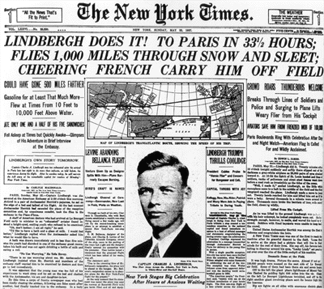
MAY 21 = Lindbergh Lands in Paris


“I’ve never landed ‘the Spirit of St.Louis’ at night before. It would be better to come in straight. But if I don’t sideslip, I’ll be too high over the boundary to touch my wheels in the area of light. That would mean circling again --- Still too high. I push the stick over to a steeper slip, leaving the nose well down --- Below the hanger roofs now --- straighten out --- A short burst of the engine --- Over the lighted area --- Sod coming up to meet me --- Deceptive high lights and shadows --- Careful, easy to bounce when you’re tired, --- Still too fast --- Tail too high --- Hold off…..Texture of the sod is gone ---- Ahead, there’s nothing but night --- Give her the gun and climb for another try? --- The wheels touch gently, off again… Ease the stick forward --- Back on the ground… Not a bad landing, but I’m beyond the light, can’t see anything ahead, like flying in fog --- slower now --- left rudder --- reverse it --- stick over the other way --- ‘The Spirit of St. Louis’ swings around and stops rolling, resting on the solidness of earth, in the center of Le Bourget. I start to taxi back toward the floodlights and hangars --- but the entire field ahead is covered with running figures!”

This is the very literal memory of Charles Augustus Lindbergh of his landing in Paris at the end of his long trans-Atlantic flight, the first ever by a man flying alone, which occurred at @ 10:32 p.m. Paris time on today’s date, May 21 in 1927. I have given it to you above almost word-for-word the way he wrote of it in his 1953 book about the event, “The Spirit of St. Louis”. Usually, when I have searched the internet, or libraries for an account of what someone was experiencing at a precise moment when something important occurred it has been a problem to find their specific impressions or experiences. Frequently, one can find general observations, or impressions. But this is the first time wherein the problem was the other way around…. where the account seemed to be too literal. But there he is – Charles Lindbergh describing his ascent into Paris and into history in terms that are very specific, and literal descriptions of specific physical acts. But this was the type of man he was: brave, visionary and…. decidedly peculiar.

The Challenge: To Fly Across the Atlantic Alone

In May of 1919, Frenchman Raymond Orteig (pictured below with Lindbergh), an owner of hotels in New York, who had been inspired by the spirit of cooperation he had witnessed during World War One, decided to put up a purse of $25,000 to the first aviator or aviators to
fly nonstop from Paris to New York or New York to Paris. In 1926, with no one having attempted the flight, Orteig made the offer again. By this time, aircraft technology had advanced to a point where a few thought such a flight might be possible. Several of the world's top aviators--including American polar explorer Richard Byrd, French flying ace Rene Fonck--decided to accept the challenge, and so did Charles Lindbergh. French WWI flying ace Charles Nungesser had made the attempt earlier in May, but had disappeared, and was presumed lost. This pointed up to Lindbergh and to the world that what he was attempting was very dangerous. Lindbergh who had taken up residence in St. Louis, which was increasingly becoming a center of air-traffic had persuaded a group of businessmen to back his construction of a plane which he called “The Spirit of St. Louis” in their honor.

"The Spirit of St. Louis" and "We"....

The Ryan Airlines Corporation of San Diego volunteered to build a single-engine aircraft to his specifications. Indeed, the plane was built almost from scratch, around Lindbergh himself. Extra fuel tanks were added, and the wing span was increased to 46 feet to accommodate the
additional weight. The main fuel tank was placed in front of the cockpit because it would be safest there in the event of a crash. This meant Lindbergh would have no forward vision, so a periscope was added. To reduce weight, everything that was not utterly essential was left out. There would be no radio, gas gauge, night-flying lights, navigation equipment, or parachute. Lindbergh would sit in a light seat made of wicker. And unlike other pilots who had attempted this jump, Lindbergh would be alone, with no navigator or co-pilot. This is where the peculiarity of Lindbergh’s personality (as I see it) first comes into play. In his 1998 biography of Lindbergh, author A. Scott Berg records:

“And yet it was strange, observed Walter Balderston (one of the plane’s designers) that whenever Lindbergh spoke of getting from New York to Paris, he always used the first person plural. ‘I heard it many times before Lindbergh left San Diego, & particularly noticed his rather peculiar conversational use of it.’ Baldesrton would write. Before there was even a plane built, ‘He simply would not use the pronoun “I” when speaking of the flight itself. In the back of his mind somewhere he may have been thinking of his financial backers, but many times he used it when by no stretch of the imagination could it have meant anything or anybody other than himself.”

Lindbergh Departs From New York

At 7:52 A.M., May 20, 1927 Charles Lindbergh gunned the engine of "the Spirit of St Louis" and took off from the dirt runway of Roosevelt Field, Long Island. As she had a lot of extra fuel aboard, the plane bounced down the muddy field, gradually became airborne and barely cleared the telephone wires at the field's edge. The crowd of 500 thought they had witnessed a miracle. And they might have. Many intrepid adventurers had ventured into the unknown in the past, but this was one man attempting it alone. To be separated from all contact with earth and living beings was a unique experience for any man, even for a comparative loner like Lindbergh. He had left with just a handful of sandwiches for food, and a little water in a canteen. And during the journey, he fought fatigue and sleeplessness, occasionally flying his plane close enough to the water that some of the spray from the white-capped ocean would come into his cockpit, slap him in the face and revive his flagging consciousness. And he many years later admitted that he at one point became delusional. And he wouldn’t just say he was having plain old hallucinations. No, these were “vaguely outlined forms, transparent, moving, riding weightless with me in the plane.” These fellows spoke to him with human voices giving him “messages of importance unattainable in ordinary life.”

Lindbergh Enters the Public Mind for Good (or ill?)

At the Le Bourget Aerodrome in Paris, tens of thousands of Saturday night revelers had gathered to await Lindbergh's arrival. On May 21, at 10:24 a.m. local time, his gray and white monoplane emerged from the
darkness and made a perfect landing in the air field. The crowd surged on "the Spirit of St. Louis", and Lind- bergh, weary from his 33 1/2-hour, 3,600-mile journey, was cheered and lifted above their heads. He hadn't slept for 55 hours. He was an immediate international celebrity. Lindbergh was in many ways the first modern media-celebrity, becoming the subject of saturation coverage and constant attention from newspaper reporters and cameramen. He wound up becoming the original victim of the first crowds of what would come to be known as the paparazzi. He would go on to marry Anne Morrow, the daughter of U.S. Diplomat and again, all too much in the public eye, would have a son, who would be kidnapped and ultimately murdered. Again in the public eye, Lindbergh and his wife would be forced to undergo the stress of the trial – “the trial of the century” it was called – and conviction of the accused murderer. In the years leading up to World War II, Lindbergh associated with the isolationist “America First “ organization, and came to be identified with many of it’s most anti-Semitic elements. But this fall from the good graces of the once adoring public, the loss of his first son, all of this was in the future on that day in 1927, when Charles Lindbergh first stepped out of “the Spirit of St. Louis” and into the lime-light, with all of its blessings and its curses.

READERS!! If you would like to comment on this, or any "Today in History" posting, I would love to hear from you!!  You can either sign up to be a member of this blog and post a comment in the space provided below, or you can simply e-mail me directly at:  krustybassist@gmail.com  I seem to be getting hits on this site all over the world, so please do write and let me know how you like what I'm writing (or not!)!!


Sources:
by A. Scott Berg, Putnam & Sons, New York, 1998.
by Charles A. Lindbergh, Scribner & Sons, New York, 1953.

+ 155.
+ 120.
+ 92.

Monday, May 19, 2014

MAY 19 = Anne Boleyn is Executed


"This morning she sent for me, that I might be with her at such time as she received the good Lord, to the intent I should hear her speak as touching her innocency alway to be clear. And in the writing of this she sent for me, and at my coming she said, 'Mr. Kingston, I hear I shall not die afore noon, and I am very sorry therefore, for I thought to be dead by this time and past my pain '. I told her it should be no pain, it was so little. And then she said, 'I heard say the executioner was very good, and I have a little neck', and then put her hands about it, laughing heartily. I have seen many men and also women executed, and that they have been in great sorrow, and to my knowledge this lady has much joy in death."

- From a letter from Sir W. Kingston, Constable of the Tower, to Thomas Cromwell, May 19th, 1536. (spelling modernized)

This was the way in which Anne Boleyn (above), one-time Queen of England faced her death on the morning of today's date in 1536. Anne was beheaded this day as her sentence for being convicted on charges of adultery and treason against her husband, King Henry VIII of England. But her real "crime" was not being able to produce a son and heir to the throne for her husband. And it was really for this that she died.

Henry VIII and His Wives

The King of England, Henry VIII (below) needed a son.  That really was the main difficulty that plagued his reign, pretty much from beginning to end.  Born in 1491, Henry had become King on the death of his father, King Henry VII in 1509.  His older brother, Arthur had married 
Catherine of Aragon, the daughter of King Ferdinand V of Spain, in 1501.  But Arthur died a few months later, so shortly after becoming King, Henry VIII married his brother's widow to honor the purpose of the marriage: an alliance with Spain.  At first the marriage went well.  Henry, 19 at the time was taken with the wit of his 25 year old wife.  But as time passed and they both grew older, Henry became bored with Queen Catherine. She had been able to produce one child, Princess Mary, but no male heir to the throne. While a female could quite legally inherit the throne, it was a male heir who would be considered strong enough to hold the throne, and thus insure the succession, and the political stability of the country.  So with Queen Catherine older and apparently unable to produce the desired prince Henry began looking around until his eternally roving eye settled upon Anne Boleyn.  

The Trouble With Anne

Anne, the daughter of an English nobleman, Thomas Boleyn had been a maid of honor in the court of Queen Catherine.  She had a playful and vivacious spirit, and as she was only in her mid-twenties when Henry turned his attention to her in early 1526, she was young enough to please Henry's vanity (Henry courting Anne below), and to bear him the son he wanted. It was for this reason that Henry broke England off  
from her official affiliation with the Catholic Church when Pope Clement VII refused to annul his marriage to Queen Catherine.  Needless to say, this separation from Rome caused huge, massive problems for Henry, his nation, and for the men around him, as well as for his successors for many decades after. He married Anne Boleyn on January 25, 1533. Again, the trouble with producing a son got in the way.  Anne was able to produce a child, Elizabeth, later in 1533.  But she was only able to mis-carry after that.  We now know of course that it is the father's chromosomes that determine the child's gender.  But back in these days it  was definitely considered a woman's matter.  So if the King wanted a son, and he didn't get one, the Queen soon became persona non grata.  Such became the case with Queen Anne.  By 1536, the Queen had been jailed on mostly (but not entirely) trumped-up charges of adultery with several men,  and on May 2, she as arrested and sent to the Tower of London.  She was tried and convicted on May 15.  

Queen Anne's Execution

For her "crimes", Queen Anne was sentenced to death by beheading, in this case by a swordsman from France. The following account by "Claire" on the site "The Anne Boleyn Files" (location listed below) gives a touching account of Queen Anne's final moments:

"Dressed in a robe of grey or black damask trimmed with ermine, with a crimson kirtle underneath and an English style gable hood, Anne took her final walk out of the Queen’s Lodgings, past the Great Hall, through Cole Harbour Gate, along the western side of the White Tower to the black draped scaffold. Kingston helped her up the scaffold steps and Anne stepped forward to address the crowd (which) fell silent as they gazed at their queen, who one witness described as being 'never so beautiful'. Anne then gave her final speech:"

Mindful of the fact that she needed to accept her fate with a brave and loyal face in order to protect the safety of her daughter Elizabeth, Anne gave a suitably contrite address:

“Good Christian people, I have not come here to preach a sermon; I have come here to die. For according to the law and by the law I am judged to die, and therefore I will speak nothing against it. I am come hither to accuse no man, nor to speak of that whereof I am accused and condemned to die, but I pray God save the King and send him long to reign over you, for a gentler nor a more merciful prince was there never, and to me he was ever a good, a gentle, and sovereign lord. And if any person will meddle of my cause, I require them to judge the best. And thus I take my leave of the world and of you all, and I heartily desire you all to pray for me.”

Henry VIII would live on until 1547 with the intervening years being marked by turmoil, bloodshed, and four more wives, only the last of whom, Catherine Parr would manage to survive him.  He did in fact get his son and heir from his next wife, Jane Seymour who died shortly after giving birth to their son, who would take the title of  Edward VI.  But poor little Edward was an unhealthy child and only lived for three years as King before his death, and was succeeded by Mary, Henry's child with Catherine of Aragon, and ultimately by Elizabeth, his child with Anne Boleyn, who would reign for 70 years of success and stabilization.  Anne Boleyn was buried in an unmarked grave in the Chapel of St Peter ad Vincula. Her skeleton was found and identified during renovations of the chapel in 1876, during the reign of Queen Victoria. Her grave is now marked in the marble floor of the chapel (pictured below).


Sources:


"Kingdoms of Europe" by Gene Gurney, Crown Publishers, New York, 1982


Sunday, May 18, 2014

MAY 18 = Mount St. Helens Erupts


“Within a matter of seconds, perhaps 15 seconds, the whole north side of the summit crater began to move simultaneously. The nature of movement was eerie. The entire mass began to ripple and churn up, without moving laterally. Then the entire north side of the summit began sliding to the north along a deep-seeded plane. We were amazed and excited with the realization that we were watching this landslide of unbelievable proportions. We took pictures of this slide sequence occurring, but before we could snap off more than a few pictures, a huge explosion blasted out…..We neither felt nor heard a thing, even though we were just east of the summit at this time.”

This was the recollection of geologists Keith and Dorothy Stoffel of the eruption of Mount Saint Helens which took place at 8:32 a.m. on today’s date, May 18, in 1980. The Stoffels were flying in a four seat Cessna airplane high enough above the erupting volcano to safely dodge it’s cloud of ash just in the nick of time. Many who were down below were not so lucky.

Mount St. Helens Begins to Rumble, but Harry Truman Remains Defiant

Seismic activity at Mount St. Helens, which lies 96 miles south of Seattle, Washington started on March 16, when 4.2-magnitude tremor was recorded. Activity continued, and between March 23 and 24, there were 174 different tremors recorded. On March 27, the first eruption happened when a 250-foot wide vent opened up on top of the mountain. Ash shot 10,000 feet in the air, and some of this rained down nearly 300 miles away in Spokane. This peculiar rain of ash caused static electricity and lightning bolts. Local authorities issued a hazard watch for a 50-mile radius around the mountain. The National Guard erected road blocks to keep people from getting into the area, but these were easily avoided by using the many unguarded logging roads in that area. Indeed, many logging companies were so reluctant to give up their lucrative logging business in the region, that they kept their men on the job working right up until the day before, issuing devices to measure the ash content in the air to their workers. It was only the fact that the Mountain had the goodness to blow its stack on a Sunday, the loggers day off that saved hundreds of logger’s lives. Many locals simply refused to go. Harry Truman, 84 (below, no relation to the former president) was one resident who refused to go.
"That mountain will never hurt me!” he said, echoing his namesake’s stubborn- ness. “When you live someplace for 50 years, you either know your country, or you’re stupid.”


Harry Truman Gets the Mountain's Answer

Then the mountain answered Harry’s declaration on May 18 with a sudden 5.1-magnitude earthquake and eruption that shook the mountain, with the entire north side of the peak rippling and blasting out ash at 650 miles per hour, as it literally collapsed in on itself. A cloud of ash, rocks, gas and glacial ice raced down the side of the mountain at 100 mph, and fourteen miles of the Toutle River were buried up to 150 feet deep in the debris. Magma, at 1,300 degrees Fahrenheit, flowed for miles around the blast zone. The 24-megaton blast wrecked a 230-square-mile area around the mountain. Geologist Dave Johnson, who had been camping out on top of Coldwater Ridge, which was six miles away from the crater and was directly in line with the blast, at the United States Geological Survey (USGS)’s Coldwater II Observation station just barely had enough time to radio in one last report: "Vancouver, Vancouver, this is it!" Johnston, his Jeep, his 22 foot trailer, and all of his monitoring equipment were swept away in the volcanic deluge, never to be found.

The Damage Caused to the Region by Mt. St. Helens

Millions of trees were scorched and burned by the hot air alone. When the glacier atop the mountain melted, a massive mudslide wiped out homes and dammed up rivers throughout the area. The plume of ash belched out for nine hours; easterly winds carried it across the state and as far away as Minneapolis, Minnesota. The falling ash clogged carburetors and thousands of motorists were stranded. Within three hours, the plume of ash and pumice had completely blocked out sunlight to over half of the state. Light-activated streetlamps in Spokane and Yakima went on at noon that day, which was thereafter known as “Ash Sunday”. The cloud quickly traveled on the wind, darkening the skies over Idaho and Montana, and arrived in Boston, Massachusetts in two days. In 17 days, it arrived again on the west coast, having circumnavigated the globe. Fifty-seven people died overall from suffocation, burns and other assorted injuries. Twenty-seven bodies were never found. Mount St. Helens went from 9,600 feet high to only 8,300 feet high in a matter of seconds. Harry Truman, whose feisty, though unrelated namesake had survived a predicted political eruption in 1948 to come out on top, had not been nearly so lucky. He had declared himself to be smart enough to know his mountain, but the mountain had the last laugh, as his was one of those whose body was never found.
Above: Mt. St. Helens as she looks today.

But, as devastating as the eruption of Mt. St. Helens was to the area, the blast area provided a one-of-a-kind laboratory on the amazing resilience of Mother Nature in the face of her own fury.  The area has recovered much more quickly than scientists had thought it would, and in ways which they never would have guessed. For details on this fascinating story, read my article FORMERLY on "Suite 101", but dropped from their site for reasons which remain unclear... to me anyway.  So for further reading on Mt. St. Helens read my article on the sister site to "Today in History".. "Today in History II" =
http://todaysstoryinhistory.blogspot.com/2012/05/may-18-mt-st-helens-ruin-and-recovery.html


READERS!! If you would like to comment on this, or any "Today in History" posting, I would love to hear from you!!  You can either sign up to be a member of this blog and post a comment in the space provided below, or you can simply e-mail me directly at:  krustybassist@gmail.com  I seem to be getting hits on this site all over the world, so please do write and let me know how you like what I'm writing (or not!)!!


Sources:
by Rob Carson, Sasquatch Books, Seattle Washington, 1990.

http://en.wikipedia.org/wiki/Mount_St._Helens

http://www.history.com/this-day-in-history/mount-st-helens-erupts


+ 234.
+ 111.
+ 85.