Tuesday, June 10, 2014

JUNE 10 = First "Witch" is Hung in Salem


Above: "Examination of a Witch" Thompkins H. Matteson, 1853.

Magistrate: "Pray, what ails these people?"
Martin: "I don't know." 
Magistrate: "But what do you think ails them? 
Martin: "I don't desire to spend my judgement upon it."
 Magistrate: "Don't you think they are bewitched?" 
Martin: "No I do not think they are." 
Magistrate: "Tell us your thoughts about them then."
 Martin: "No, my thoughts are my own, when they are in; but
 when they are out they are another's. Their Master..."

 Magistrate: "Their Master? Who do you think is their Master?"
 Martin: "If they be dealing in the Black Art, then you may
 know as well as I."
 
Magistrate: "Well, what have you done towards this?" 
Martin: "Nothing at all." 
Magistrate: "Why, 'tis your appearance." 
Martin: "I cannot help it." 
Magistrate: "Is it not your Master? How comes your appearance
to hurt these?"
 
Martin: "How do I know? He that appeared in the shape of
Samuel, a glorified Saint, may appear in anyone's shape."


Susannah Martin's efforts to defend herself against charges of practicing witchcraft, as shown above were to prove unsuccessful. The sixty-seven year old widow was one of twenty "witches" who were executed in the witch trials of Salem, Massachusetts the first of whom was hung on today's date, June 10 in 1692.

"The Circle Girls" Start All the Trouble

The charges were originally made against an old homeless woman named Sarah Good, and a slave woman named Tituba. The hysteria began with a group of young girls, known as "the circle girls". These girls had been a group who had on several occasions sat in the home of the Reverend Samuel Parris where Tituba, who was his slave, told them tales of magic and spirits from her native lands of the the Caribbean Islands. When the girls began experiencing various fits and convulsions, a local doctor declared them to be victims of witchcraft. They accused Tibuta of being source of their afflictions - as an outsider, and also being dark-skinned, she was an object of suspicion to the conformity-minded Puritans and thus a natural target for such accusations. Sarah Good, who often begged door-to-door with her children was also a convenient target. But once the girl's accusations caught on, virtually anybody could fall under such suspicions. With the encouragement of some local adults the charges even spread beyond Salem into surrounding areas.

Bridget Bishop Goes to the Gallows on June 10.

(Pictured: Bridget Bishop)
In June 1692, a special Court convened in Salem under Chief Justice William Stoughton to judge the accused. The first defendant dragged into the dock was one Bridget Bishop of Salem. Bishop was known in the community for what was seen as her dubious moral character, having been married three times. Also, she was known to frequent taverns, and dressed in a way which was viewed by the Puritans as flamboyant. She pleaded her innocence but like Tituba, she was different and thus an easy target. Bishop was found guilty and executed by hanging on today’s date, June 10. Thirteen more women and five men would follow her to the gallows, and one man, Giles Corey, was executed by crushing. Most of those tried were condemned on the basis of the witnesses' behavior during the actual proceedings, characterized by supposed fits and hallucinations.

The Witch Accusations Finally Begin to Die Down

In October of that year, Governor William Phipps took the case out of the Salem locality, and ordered it tried in the Superior Court of Judicature, wherein the more sensational charges of the young girls, such as bizarre physical transformations, would not be accepted as evidence. Under these circumstances, the charges fell apart, and the executions ceased. Those sentenced to death and awaiting their trip to the gallows were pardoned, and others in jail and awaiting trial were released.

Causes of the "Circle Girls" Convulsions?

Various medical explanations have been put forward over recent decades to explain the fits and convulsions of the "Circle Girls" which started this whole wretched mess. One such was published in 1976, suggesting that the bread which some of the girls may have eaten might have been infected by a fungus named "Ergot" which produces symptoms similar to the drug "LSD".  Others have dismissed this in favor of other explanations including Encephalitis, spread by birds, or Lyme Disease spread by ticks which would have been easily picked up in some of the forested areas near Salem. There have also been suggestions that their "fits" may have been caused by Post-Traumatic Stress Disorder suffered by some of these girls as a result of experiences during "King Philip's War"; a series of skirmishes with local Indigenous American tribes allied with the French which occurred around this time.

Whatever the actual causes, one of the prosecutors also might be considered the final victim as well. The Reverend Nicholas Noyes had declared the unfortunate Sarah Good to be a witch, and urged her to confess. She refused, saying: "I am no more a witch than you are a wizard, and if you take away my life, God will give you blood to drink." Sarah Good was indeed hung. But twenty-five years later, the Rev. Noyes died of internal bleeding -- having literally choked on his own blood.


READERS!! If you would like to comment on this, or any "Today in History" posting, I would love to hear from you!!  You can either sign up to be a member of this blog and post a comment in the space provided below, or you can simply e-mail me directly at:  krustybassist@gmail.com  I seem to be getting hits on this site all over the world, so please do write and let me know how you like what I'm writing (or not!)!!

Sources:

by Paul Boyer and Paul Nissenbaum, 1974.


http://www.history.com/this-day-in-history/first-salem-witch-hanging

http://en.wikipedia.org/wiki/Medical_explanations_of_bewitchment

+ 143.
+ 134.
+ 107.

Monday, June 9, 2014

JUNE 9 = McCarthy Crashes on National TV


"Senator MCCARTHY. Jim, will you get the news story to the effect that this man belonged to this Communist-front organization?...."
Mr. WELCH. You won’t need anything in the record when I have finished telling you this.
Until this moment, Senator, I think I never really gauged your cruelty or your recklessness. Fred Fisher is a young man who went to the Harvard Law School and came into my firm and is starting what looks to be a brilliant career with us.....Little did I dream you could be so reckless and cruel as to do an injury to that lad..... It is, I regret to say, equally true that I fear he shall always bear a scar needlessly inflicted by you. If it were in my power to forgive you for your reckless cruelty, I will do so. I like to think I am a gentleman, but your forgiveness will have to come from someone other than me.
Senator MCCARTHY. Mr. Chairman.
Senator MUNDT. Senator McCarthy?
Senator MCCARTHY. May I say that Mr. Welch talks about this being cruel and reckless. He was just baiting; he has been baiting Mr. Cohn here for hours, requesting that Mr. Cohn, before sundown, get out of any department of Government anyone who is serving the Communist cause....
Mr. WELCH. Senator, may we not drop this? We know he belonged to the Lawyers Guild, and Mr. Cohn nods his head at me. I did you, I think, no personal injury, Mr. Cohn.
Mr. COHN. No, sir.
Mr. WELCH. I meant to do you no personal injury, and if I did, beg your pardon.
Let us not assassinate this lad further, Senator. You have done enough. Have you no sense of decency sir, at long last? Have you left no sense of decency? {Click on these highlighted words to hear an actual recording of the hearing.}
Senator MCCARTHY. I know this hurts you, Mr. Welch. But I may say, Mr. Chairman, on a point of personal privilege, and I would like to finish it—
Mr. WELCH. Senator, I think it hurts you, too, sir. "

Such was the testimony before Congress that day, today's date - June 9 in 1954 - when Senator McCarthy finally went too far, and in nationally televised hearings found himself being dressed down by an outraged Joseph N. Welch. An embarrassed McCarthy would eventually be censured by his fellow senators as a result of this exposure to a national TV audience.

Senator Joseph McCarthy and His Search for Communists

Senator Joseph McCarthy (R-Wisconsin) had enjoyed a meteoric rise to power, influence and public notoriety in the U.S. Congress when he charged in February 1950 that "hundreds" of "known communists" were in the Department of State. This was during a period of our nations history when the threat of communist infiltration into our highest echelons of government seemed all too real. The case of Alger Hiss (above, right), a high state department official who had been convicted of perjury in denying communist affiliations was very much in the public mind. Hiss had been convicted in January of 1950, and so the charges of McCarthy fell on very fertile ground of suspicion in the public mind coming as they did during the very next month. In the years that followed, McCarthy became the primary attacker of those who were suspected of communist affiliations, real or imagined. These years of the "Red Scare" were a time when many of Americans became worried that communists had infiltrated every aspect of American life. Behind closed-door committee hearings, McCarthy used this public suspicion as a ram with which to bully, and smear witnesses who were too terrified to fight back. In this way, he destroyed many careers and lives in the process. There were in fact communists who had infiltrated our government. While Alger Hiss sought for many years after to portray himself as a victim of a "witch hunt", he was guilty. But McCarthy's tactics did great harm to our country by his reckless attacks upon anybody who dared stand up to him. By 1953, with Republican Dwight D. Eisenhower as president there was less official sanction to his activities. McCarthy's increasingly erratic behavior became unacceptable to the president and the senator saw his clout slowly drying up. In a last-ditch effort to revive his flagging fortunes McCarthy opened hearings into the Army.

The Army McCarthy Hearings

The Army-McCarthy hearings dominated national television from April to June 1954. A subcommittee of the Senate Committee on Government Operations was seeking to learn whether Senator McCarthy (left) had used his influence to improperly gain preferential treatment for a former member his staff, Pvt. G. David Schine who had been drafted. McCarthy claimed that the army was trying head off his investigations of army security practices through blackmail and intimidation. The congressional hearings were among the first ever that were televised, and they garnered national attention because of McCarthy's notoriety.
Joseph N. Welch (right), a very plain, soft-spoken lawyer with a sharp wit and a very staid sense of what was right, represented the Army. During the course of the hearings that week, Welch turned aside each and every one of McCarthy's charges. The senator, for his part, became increasingly irritated, bellowing "point of order, point of order," yelling at witnesses, and declaring that a greatly decorated general was a "disgrace" to his uniform.

McCarthy Steps Too Far...

On June 9, 1954, however, McCarthy went too far. He once again became agitated at Welch's steady dissection of each of his arguments and witnesses. and charged that Frederick G. Fisher, a young associate in Welch's law firm, had been a long-time member of an organization that was a "legal arm of the Communist Party." Welch was obviously dumb-founded at this gratuitous slur against a bright young associate, and decided that it was time to unload upon McCarthy. As he strained to maintain his composure, he looked McCarthy dead in the eye and declared, "Until this moment, Senator, I think I never really gauged your cruelty or your recklessness." With McCarthy looking on and for once, temporarily stunned into silence, Welch asked, "Have you no sense of decency, sir, at long last?" The audience of citizens and newspaper and television reporters broke out in wild and sustained applause. Just a week later, the hearings into the Army came to a close. McCarthy, having been exposed as a reckless bully before the simple honesty of Mr. Welch, was officially condemned by the U.S. Senate for contempt against his colleagues in December 1954. During the next two-and-a-half years McCarthy spun into an alcoholic wreck of his former self. Still in office, he died in 1957.


READERS!! If you would like to comment on this, or any "Today in History" posting, I would love to hear from you!! You can either sign up to be a member of this blog and post a comment in the space provided below, or you can simply e-mail me directly at: krustybassist@gmail.com I seem to be getting hits on this site all over the world, so please do write and let me know how you like what I'm writing (or not!)!!

Sources:

http://historymatters.gmu.edu/d/6444

http://en.wikipedia.org/wiki/Joseph_N._Welch

http://en.wikipedia.org/wiki/Army%E2%80%93McCarthy_hearings

+ 125.


Friday, June 6, 2014

JUNE 6 = "D - Day" 76 Years Later


"Omaha Beach was a night- mare. Even now it brings pain to recall what happe- ned there on June 6, 1944. I have returned many times to honor the valiant men who died on that beach. They should never be forgotten. Nor should those who lived to carry the day by the slimmest of margins. Every man who set foot on Omaha Beach that day was a hero."

- General Omar Bradley, "A General's Life", 1983

On today's date, June 6 in 1944 - 76 years ago -the forces the Western Allies landed on the beaches of Normandy in Nazi-occupied France. This was the largest amphibious operation in military history with 160,000 men hitting the beach that morning starting at 6:30 a.m. The landings were preceded by airborne attacks through the early morning hours of June 6 by 24,000 Allied paratroopers. There were 5,000 ships supporting the invasion with naval bombardment as well as carrying the troops and supplies. The enemy were the forces of Adolf Hitler's Nazi Germany who had occupied France since 1940, imposing untold brutality. The Allied forces were the armies of the United States, Great Britain, Canada, Australia, the Free French, as well as ships and contingents of many of the countries which had been overrun by the Nazis. This was quite literally democracy and freedom versus the forces of tyranny, and as would become apparent as the invading allies moved inland and uncovered the murderous death camps, the forces of darkness and evil.

These are basic facts of the operation that day, called "D Day". But this battle (code named "Operation Overlord")... this one day... was such a huge and complex undertaking that entire books, movies and TV documentaries have been devoted to it.. This one engagement would decide whether the Nazi tyranny could be overthrown, o whether it would last indefinitely. Every part of this story would qualify for a separate posting of it's own. But for our purposes here I shall choose one particular facet of the story and focus on that. And as the worst of the fighting -- the bloodiest, yet as General Bradley (commander of the U.S. forces in Normandy) tells us above the most heroic part of the story came at Omaha Beach, that is where I shall focus, attempting to relate what it was like to be there.

Omaha Beach - A Killing Field

Omaha Beach was so bloody is because of its topo- graphy and its po- sition in the Allied attack zone: right in the middle of it - a fifty mile (80 kilometer) stretch of the of northwestern France's Normandy peninsula, divided into Sword, Juno, Gold, Omaha and Utah Beach (click on the above map to enlarge). The British, Canadian, and Free French were assigned the Sword, Juno and Gold beaches, the Americans were assigned Omaha and Utah Beaches. Failure to take it could endanger the entire operation by leaving the Allied forces divided. The German commander, Field Marshall Erwin Rommel, an intelligent officer (to say the least) saw that this area would be the key to any Allied assault, and had put up the strongest defenses in Normandy here. Omaha was overlooked by tall cliffs (easily visible in the middle of the above photograph) from which the Germans could blanket the whole beach with machine gun fire. The beach leading up from the water was filled with obstacles and mines. Part of the beach was called "shingles" - a line of small stones which offered a very small amount of protection from the machine gun fire. These were lined with barbed wire which made it impassable without exposure to the machine guns. And staying by the shingles too long left the troops exposed to German mortar fire. And with high cliffs enclosing it, Omaha could not be gone around.

"A hurricane of enemy machine gun fire..."

As if the above was not enough, the German forces defending Omaha were not the soft, half-loyal Russian and Polish conscripts that Allied intelligence had reported, but the crack, battle-hardened 352'nd Division. Their artillery made it nearly impossible for the men to be taken close to the beach. Thus from the moment they left their landing craft, the American infantry was in high water under heavy fire. As General Bradley sorrowfully recorded: "All men instantly came under a hurricane of enemy machine gun, mortar and artillery fire. Dozens died or fell wounded, many drowning in the sea. There was no cover. The men lay in the sand or shallow water, unable to return fire, or crouched behind stranded landing craft. For several hours, the beach and the water just beyond was a bloody chaos."

Bradley gives "unstint- ing praise" to the ships of the U.S. navy, whose destroy- ers repeatedly risked running aground by steaming in close enough to the beach to give the Army troops cover with their big naval guns. But Omaha was still nearly impassable. Nearly entire regiments were wiped out within a few minutes, leaving many survivors disoriented. Sgt. Thomas Valance of the 116'th Regiment recalled that after being severely wounded, he "... staggered up against the seawall and sort of collapsed there, and as a matter of fact spent the whole day in that same position. Essentially my part in the invasion ended by having been wiped out as most of my company was. The bodies of my buddies were washing ashore and I was the one live body in amongst so many of my friends, all of whom were dead, in many cases severely blown to pieces."


Private John Mc Phee of the 16'th regiment recalled being exhausted by all of the heavy equipment he had to carry: "Our life expectancy was about zero. We were burdened down with too much weight. We were just pack mules. I was very young in excellent shape. I could walk for miles, endure a great deal of physical hardship, but I was so seasick I thought I would die. In fact, I wished I had. I was totally exhausted." Pvt. Mc Phee was hit three times, and luckily for him was dragged to safety by his buddies and evacuated.

Dealing With Chaos and Moving Off the Beach

With so many higher ranking officers being wounded or killed it was frequently left to Captains and lower ranking officers to organize the chaos from different parts of units being thrown together in the chaos of battle and find some way of moving off the very slim sliver of beach they were holding onto and moving up the cliffs. Lieutenant John Spaulding of the 16'th regiment's E Company lead one such movement, climbing one of the many bluffs looking down on the beach: "We still could see no one to the right and there was no one up to us on the left... we didn't know what had become of the rest of E Company. Back in the water boats were in flames. I saw a tank ashore, knocked out. After a couple of looks back, we decided we wouldn't look back anymore." Spaulding lead his men through a minefield with the help of Sergeant Fred Bisco, who yelled "Lieutenant, watch out for the damn mines... but we lost no men coming through them, although H Company coming along the same trail a few hours later lost several men. The Lord was with us and we had an angel on each shoulder on that trip."

Captain Joseph T. Dawson was leading a company of men through a similar minefield situation when he met up with Spaulding's group. They were proceeding "... up to the crest of the ridge which overlooked the beach. We got about halfway up when we met the remnants of a platoon from E Company, commanded by Lt. Spaulding. This was the only group -- somewhere less than twenty men -- we encountered who had gotten off the beach." The group then organized an attack: "Above me, right on top of the ridge, the Germans had a line of defenses with an excellent field of fire. I kept the men behind and along with my communications sergeant and his assistant, worked our way up to the crest of the ridge. Just before the crest was a sharp perpendicular drop, and we were able to get up the crest without being seen by the enemy. I could now hear the Germans talking in the machine gun nest immediately above me. I then threw two grenades, which were successful in eliminating the enemy and silencing the machine gun which had been holding up our approach."

General Eisenhower Pays Tribute

Overall the Allies suffered 12,000 casualties (men killed or wounded) in operations that took place on June 6, 1944. These included operations of airborne troops, naval vessels, and medical corpsmen operating on the beach, whose heroic contributions to the victory won that day we simply didn't have room to include in this posting, as extended as it is. In an interview with Walter Cronkite on the 20'th Anniversary of D Day in 1964 Dwight D. Eisenhower the Supreme Allied Commander who gave the order to go ahead with the invasion on June 6 said:

"It's a wonderful thing to remember what those fellows twenty years ago were fighting for and sacrificing for, what they did to preserve our way of life. Not to conquer any territory, not for any ambitions of our own. But to make sure that Hitler could not destroy freedom in the world. I think it's overwhelming. To think of the lives that were given for that principle, paying a terrible price on this beach alone on that one day... But they did it so that the world could be free. It just shows what free men will do rather than be slaves."


READERS!! If you would like to comment on this, or any "Today in History" posting, I would love to hear from you!! You can either sign up to be a member of this blog and post a comment in the space provided below, or you can simply e-mail me directly at: krustybassist@gmail.com I seem to be getting hits on this site all over the world, so please do write and let me know how you like what I'm writing (or not!)!!


Sources:

by Omar N. Bradley & Clay Blair, Simon & Schuster, New York, 1983


by Stephen E. Ambrose, Touchstone Books, New York, 1995.


edited by Jon E. Lewis, Carroll & Graf Publ. Inc., New York, 1998.


http://en.wikipedia.org/wiki/Normandy_landings

+ 4146.
+ 279.

Thursday, June 5, 2014

JUNE 5 = Robert F. Kennedy is Assassinated


On today's date, June 5, in 1968, Senator Robert Francis Kennedy of New York was assassinated shortly after he won the California Primary for the Democratic Nomination for the Presidency of the United States. The assassination took place shortly after midnight. The primary election day had been on June 4, and RFK had addressed supporters in the Ballroom of the Embassy Hotel at about 12:10 a.m. He left the ballroom through a back way; the kitchen and pantry area. At that time Secret Service protection was only provided for incumbent presidents, so RFK's only security was provided by William Barry, a former FBI agent, and by two former pro athletes, one of whom was former football star Rosey Grier. During the campaign RFK had welcomed contact directly with the public and often shook hands with the crowds of people who came out to see him. Unfortunately, this time, there was an individual waiting for him with a gun. The Senator was shot three times behind his right ear. After an interval of intense confusion and horror, RFK was taken to Central Receiving Hospital, and then shortly after to the Hospital for the Good Samaritan, where after surgery lasting over three hours he died the next day at @ 1;45 a.m., nearly 26 hours after the shooting.

RFK and Senator Edward M. Kennedy's Eulogy

Those are the barest of facts of the terrible events of this day so long ago. I was only eight years old at the time, and I can remember it. I can remember asking my mother what the word "assassinate" meant. I can recall in my child's imagination the ghost of the Senator meeting the ghost of his late brother, both in their dark business suits and telling him what had happened. Those of you who are old enough to remember your reactions at the time are welcome to write in to me to tell me about them, and I will publish them here. He was not a perfect man. As Attorney General during the administration of John F. Kennedy, he served as his brother's protector, and frequently a vicious one. He came to earn the enmity of many politicians... it is known that RFK and Lyndon B. Johnson cordially despised each other. Nevertheless, he also earned the enmity of the organized crime leaders whom he put behind bars and also of such figures as Jimmy Hoffa - the corrupt head of the Teamster's Union. And he earned the undying love and affection of those poor and minority Americans whose cause he took up. As for the cause of peace in Vietnam, we are left as we were with his brother the President to the melancholy consideration of what might have been. Would he have won the Democratic Nomination? Probably. Would he have defeated Nixon in the election that November? Possibly. We'll just never know.

But I choose on this day not to dwell on what happened that night. I REFUSE to even mention the name of his murderer, nor to dignify the many conspiracy theories that have gown up around this event with any special mention. I choose instead to remember the life of this remarkable man by quoting (in part) the very moving eulogy delivered by his brother, Senator Edward M. Kennedy at RFK's funeral on June 8. A video of these excerpts can be found at:
https://www.youtube.com/watch?v=aV0MKikJraE

"On behalf of Mrs. Robert Kennedy, her children and the parents and sisters of Robert Kennedy, I want to express what we feel to those who mourn with us today in this Cathedral and around the world. We loved him as a brother and father and son. From his parents, and from his older brothers and sisters – Joe, Kathleen and Jack – he received inspiration which he passed on to all of us. He gave us strength in time of trouble, wisdom in time of uncertainty, and sharing in time of happiness. He will always be by our side.

Love is not an easy feeling to put into words. Nor is loyalty, or trust or joy. But he was all of these. He loved life completely and lived it intensely.

What he leaves us is what he said, what he did and what he stood for. A speech he made to the young people of South Africa on their Day of Affirmation in 1966 sums it up the best, and I would read it now:
"There is a discrimination in this world and slavery and slaughter and starvation. Governments repress their people; and millions are trapped in poverty while the nation grows rich; and wealth is lavished on armaments everywhere. These are differing evils, but they are common works of man. They reflect the imperfection of human justice, the inadequacy of human compassion, our lack of sensibility toward the sufferings of our fellows.

But we can perhaps remember – even if only for a time – that those who live with us are our brothers; that they share with us the same short moment of life; that they seek – as we do – nothing but the chance to live out their lives in purpose and happiness, winning what satisfaction and fulfillment they can.


Surely this bond of common faith, this bond of common goal, can begin to teach us something. Surely, we can learn, at least, to look at those around us as fellow men. And surely we can begin to work a little harder to bind up the wounds among us and to become in our own hearts brothers and countrymen once again.

Like it or not, we live in times of danger and uncertainty. But they are also more open to the creative energy of men than any other time in history. All of us will ultimately be judged and as the years pass we will surely judge ourselves, on the effort we have contributed to building a new world society and the extent to which our ideals and goals have shaped that effort.

Our future may lie beyond our vision, but it is not completely beyond our control. It is the shaping impulse of America that neither fate nor nature nor the irresistible tides of history, but the work of our own hands, matched to reason and principle, that will determine our destiny. There is pride in that, even arrogance, but there is also experience and truth. In any event, it is the only way we can live."

That is the way he lived. That is what he leaves us.

My brother need not be idealized, or enlarged in death beyond what he was in life, to be remembered simply as a good and decent man, who saw wrong and tried to right it, saw suffering and tried to heal it, saw war and tried to stop it. Those of us who loved him and who take him to his rest today, pray that what he was to us and what he wished for others will some day come to pass for all the world.

As he said many times, in many parts of this nation, to those he touched and who sought to touch him:
"Some men see things as they are and say why. I dream things that never were and say why not."

A memory of June 5, 1968 from Karenina Nallick:


Hey Brian and all others with memories of Robert Kennedy's assassination!

These were the days of no 24/7 news coverage; no fax; no cell phone; and no internet! We all relied on scheduled news hours - typically broadcasted 6 or 7pm and 11pm on TV unless a national tragedy that might interrupt scheduled TV programming. Otherwise, radio was still heavily relied upon for breaking news.That's how I found out about Robert Kennedy. I had a heavily teething 5 month old that kept me up a good portion of the night. Around 5am, I was up again with my raw gummed infant when I had given up on sleep to prepare his breakfast pablum and formula in the kitchen. I automatically turned on the counter top kitchen radio - almost a staple in every kitchen in 1968 - to hear the announcer reporting that Robert Kennedy has died from a gunshot wound earlier, in a hotel, a mere 15 miles where I lived!

My day had already been tinged with a sleepy fogginess from lack of sleep but now, with this news, my world went completely grey - very sullenly grey. How could this happen? On the seemingly heels of his brother's assassination, President John F. Kennedy in 1963. It felt absolutely incomprehensible that this could be happening again! Oh god, I thought, is this the beginning of the end as I pressed my infant son protectively close to my bosom.

History will be the judge but that fate filled day caused me to hold life a little more closely.


Sources:


http://en.wikipedia.org/wiki/Assassination_of_Robert_F._Kennedy#cite_note-15

http://abcnews.go.com/blogs/headlines/2009/08/take-a-moment-read-ted-kennedys-euology-of-bobby/
The above website contains the complete transcript of Sen. Edward M. Kennedy's eulogy.


+ 97.


Tuesday, June 3, 2014

JUNE 4 - The Battle of Midway

"Those five minutes were to constitute one of the few truly crucial 'moments of decision' which can be isolated in the whole course of warfare. At 10:25 Nagumo stood poised on the brink of perhaps the greatest naval victory ever offered an admiral, certain to be spectacular in itself and destined to alter the balance of power between the Western and the Asian world for decades to come. At 10:30 he confronted not victory, but disaster."
- John Keegan, "The Price of Admiralty"

Admiral Yamamoto Plans to Finish off the American Carriers

In the spring of 1942, Japanese morale was riding high. The American Pacific fleet had seemingly been knocked out by a highly successful raid on Pearl Harbor on Dec. 7, 1941. The Japanese had been able to move south and consolidate most of their holdings in the Pacific- Guam, Wake Island and the Philippines, But their naval commander, Admiral Isoroku Yamamoto (above) was worried. A very intelligent man who had spent time in the United States, and who understood America’s vast industrial potential, Yamamoto knew that Japan had only a limited amount of time before America’s industries began to produce enough to put the U.S. back in the war. He had designed the Pearl Harbor raid to knock the US Pacific Fleet out of action. But his main target on Dec. 7 had been the U.S. aircraft carriers, which happened not to be present at Pearl Harbor during the attack. Yamamoto was also smart enough to realize that naval air power from aircraft carriers was going to decide the fate of the war in the huge Pacific Ocean. The Doolittle raid on Japan on April 18, 1942 made by American bombers launched from aircraft carriers had done little real damage, but had made it clear that Yamamoto’s concerns about Japanese vulnerability to attack by American carrier-borne naval aircraft had been well founded.

But the U.S. Carriers Are Waiting For Him...

So he conceived a plan to draw the American carriers into battle, and finish the job which Pearl Harbor had left undone: to destroy them. Only then would Japan be free from American interference in the Pacific long enough to really consolidate its holdings. He planned to send a huge fleet of over two hundred ships built around the carriers “Akagi”, “Kaga”, “Soryu” and “Hiryu” towards the US island of Midway, under the command of Pearl Harbor veteran Admiral Chuichi Nagumo. He would also send a diversionary attack towards the Aleutian Islands. He believed that the U.S. would have her carriers protecting her main base in Hawaii. When the attack on the Aleutians took their attention away from Hawaii, the Japanese would take Midway. The Americans would then have to respond by sending their carriers into an ambush by Japanese forces well entrenched on Midway. It was a complex plan that pivoted on the US carriers being at Hawaii, going for the bait at the Aleutians and then moving to Midway exactly when the Japanese had planned for them to. But the U.S. had broken the Japanese naval code before the Battle of the Coral Sea, and had been ready for them then. US Commander Chester W. Nimitz
had decided to follow the recommendations from his intelligence that the Japanese were now going to attack Midway. He dispatched the US carriers "Hornet" and "Enter- prise" to a spot northeast of Midway to wait for the Japanese. The commander was Admiral Raymond Spruance. The command would have gone to Admiral “Bull” Halsey, but he was in the hospital with a case of shingles. Halsey had recommended Spruance as an excellent carrier tactician. And there was one more surprise: the US carrier “Yorktown”, badly damaged at Coral Sea had been quickly repaired and was ready to join the US force along with Admiral Frank Fletcher. Thus, instead of facing two American carriers two days sailing away from Midway, the Japanese would be shocked to find three American carriers within a couple of hour’s striking distance.

Nagumo's Carriers Attack Midway on June 4....

The attack on the Aleutian Island post of Dutch Harbor went forward on June 3, but the Americans didn't take the bait. Nagumo sent his carrier bombers against Midway at 4:30 am on today's date, June 4. They did much damage to Midway. But the US had already sent an attack force against the Japanese from Midway. This found the Japanese fleet at 7:15 am. It did little real damage, but caused Nagumo to over compensate in a dangerous way. The attack from Midway convinced him that he needed to launch a second strike against the island. So he ordered his planes to switch from the torpedoes they already carried in case the US carriers were sighted to bombs for a land attack. His readiness to strike at the US force should it be sighted was therefore fatally compromised. The first word of a US force northeast of Midway came at 7:28 -- thirteen minutes after his re-arming order -- when a scout plane from the cruiser “Tone” reported “10 ships”. At 7:45, he ordered a halt to the re-arming. At 8:20, the scout added the presence of a carrier to his report; he had sighted the "Yorktown’s" attack group – where according to Japanese plans it had no business being. At this moment another strike from Midway arrived. As before, it caused little damage. But it further confused Nagumo at a time when he needed to think clearly. Between 8:40 and 9:00 a.m., Nagumo had recovered his Midway strike force, and hastened to rearm his planes back to torpedoes and other anti-ship weapons. Admiral Yamaguchi argued in favor of launching the attack immediately regardless of the weapons. But Nagumo refused. He sensed that after an interval of operational confusion, he was regaining his footing, and would soon be able to strike with his full force of bombers properly armed.

And Find the American Carriers On the Spot!!
(Pictured above: the U.S.S. "Hornet")
Unfortunately for Nagumo and the Japanese Fleet, the commander of the "Enterprise" and "Hornet" attack group, Admiral Spruance, had been looking at the situation clearly and without confusion. During those precious moments when Nagumo had been vacillating between ship and shore armaments for his planes, Spruance had been hearing of the Japanese attack on Midway, and changing his plans accordingly. Instead of launching his planes at 9:00 as he had originally planned, Spruance took advantage of the opportunity offered by the Japanese attack on Midway. He saw that the Midway attack offered him the window of possibility to catch the Japanese recovering and refueling their planes if he got the US planes to the Japanese carriers at the right moment. This would give his bombers targets loaded with flammable material at the moment of their arrival. He decided to go ahead and send his planes against their targets right then. It was a risky choice, as the earlier launch gave them that much more time in the air, using up fuel which they would need on their return trip. But he sent them all -- every dive bomber and torpedo bomber he had – between 7:00 and 8:00 a.m. And instead of circling overhead until all the squadrons were launched, he ordered them to go as soon as they were airborne.

10:25 to 10:30: The Tide is Turned in the Pacific.

The first to leave the "Enterprise" and the "Hornet", the torpedo squadrons, began arriving at their Japanese targets at about 9:30 a.m. These attacks by the torpedo plane squadrons did very little damage; almost all of them were shot down by the Japanese fighters which were flying protection over their carriers. Meanwhile, the American dive bomber squadrons were having trouble finding the Japanese carriers. This brought sheer dumb luck for the Americans into play: a US submarine, the “Nautilus” had strayed into the path of the Japanese fleet earlier, and the Japanese had dispatched the destroyer “Araski” to deal with it. The “Araski” was hurrying back to the main body of the fleet, when the US dive bombers happened to be looking for that same fleet. They saw the “Araski” and decided to follow her; maybe, just MAYBE she might lead them to their targets... and she did! As mentioned, the torpedo squadrons had failed to do any serious damage, but their attack had been important for two reasons: it kept the Japanese from launching their own attacks against the US fleet, and it brought their fighter cover down to sea level, instead of at their patrol altitudes. Thus when the US dive bombers found the Japanese fleet at about 10:25 their carriers were unprotected by their fighters, and their decks were loaded with planes that were heavily armed, as well as gas lines and discarded land bombs all over the place from Nagumo’s earlier change of orders. Nagumo had in fact finally lined up his planes, gotten them re-fueled and re-armed and given the order to launch when ready at about 10:20. But at 10:25, the US dive bombers arrived and finding no Japanese fighters to oppose them, came roaring down on the Japanese from 14,000 feet up.


In the next five minutes, they changed the course of the war, and brought upon Nagumo and his fleet that (Pictured: The "Hiryu" dodges U.S. bombs) very disaster which was described by John Keegan in the quotation which began this posting. The US Dive bombers rained all hell down upon the Japanese carriers. Not only were they hitting them, but with their decks covered with fuel, bombs, and heavily armed planes, the hits had twice the damaging effect. Japanese Commander Mitsuo Fuchida witnessed the destruction from the “Akagi”:

“At 10:24, the order to start launching came from the bridge by voice tube. At that moment a lookout screamed, ‘Hellcat divers!!’ I looked up to see three black enemy planes plummeting towards our ship. Some of our machine guns managed to fire a few bursts but it was too late. The plump silhouettes of the American Dauntless dive-bombers quickly grew larger and then a number of black objects suddenly floated eerily from their wings. Bombs! Down they came straight towards me. I fell intuitively to the deck and crawled behind a command post mantlet.”
Also on board “Akagi” was Nagumo’s Chief of Staff, Ryunosoke Kusaka:

“When I got down (from the bridge), the deck was on fire and anti-aircraft and machine guns were firing automatically having been set off by the fire aboard ship. I had my hands and feet burned… Bodies were all over the place…. That is the way we eventually abandoned “Akagi” – helter-skelter, no order of any sort.”

The U.S.S. Yorktown is Sunk

Three of the four Japanese aircraft carriers, the “Akagi” the “Kaga” and the “Soryu” were utterly smashed in five minutes by the timely arrival of the American dive-bombers. But the Japanese fleet, though fatally crippled, still had fight left. The one Japanese carrier to escape the initial conflagration, the “Hiryu” managed to launch an air strike which located and attacked the American carrier “Yorktown”. (Pictured below: the "Yorktown" under attack.)

She was badly damaged and had to be aban- doned before being sunk by four torpedoes from a Japanese submarine, the “I-168” on June 6. But Admiral Fletcher aboard “Yorktown” before the Japanese attack had suspected that one of their carriers had escaped the attack at 10:25, and had sent off ten bombers to seek her out.  At 2:45, they found "Hiryu", and then dive bombers attacked and destroyed her at 5:00. She went down early on the morning of June 5.

The Japanese Never Recover From Their Defeat at Midway.

It would be difficult to overstate the caliber of disaster suffered by the Japanese at the Battle of Midway. Yamamoto was able to return from Midway with most of his surface vessels – the Battleships and Cruisers which had made up the bulk of his force intact. But as the Japanese themselves had so ably demonstrated, not only at Pearl Harbor, but also in their sinking of the British Battleship “Prince of Wales” the big Battleships, however impressive and powerful they may have been, were at the mercy of carrier-borne naval aircraft. The Japanese carrier striking power had been dealt a blow – four big fleet carriers had been destroyed – from which it would never fully recover. Nearly three years of bloody, and terrible fighting remained, but the tide had been turned. The Japanese Navy would never again go on the offensive. And the road which would lead ultimately to the destruction of Hiroshima and Nagasaki had begun.


READERS!! If you would like to comment on this, or any "Today in History" posting, I would love to hear from you!!  You can either sign up to be a member of this blog and post a comment in the space provided below, or you can simply e-mail me directly at:  krustybassist@gmail.com  I seem to be getting hits on this site all over the world, so please do write and let me know how you like what I'm writing (or not!)!!

Sources:

"The Price of Admiralty" by John Keegan, Penguin Books, New York, 1988.

THE AMERICAN HERITAGE PICTURE HISTORY OF WORLD WAR II  by C.L. Sulzberger, American Heritage Publ. Co. Inc., 1966.

"Nimitz" by E.B. Potter, Naval Inst. Press, Annapolis, MD.,1976.

"Decision at Sea: Five Naval battles That Shaped American History" by Craig L. Symonds, Oxford Univ. Press, Oxford, New York, 2005.

"Midway" Directed  by Jack Smight, 1976

+ 125.
+ 96.
+103.

Monday, June 2, 2014

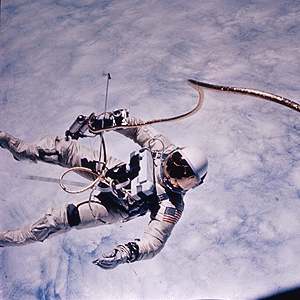
JUNE 3 = Lt. Col. Ed White Walks in Space


"In 1962, prep- arations for space- science investi- gations on manned missions were under- taken by NASA on the assumption that man's flexibility, judgement, sensory perceptions, and manipulative abilities would be useful in performing a variety of experiments. The soundness of this assumption has been borne out by the early two-man Gemini flights when man's unique ability to control, modify, and reschedule contributed greatly to the success of the scientific portion of the missions."

- George E. Mueller & Homer E. Newell, Associate Administrators at NASA.

"This is the saddest moment of my life..."

- Astronaut Edward H. White on re-entering the Gemini IV spacecraft after his space walk.

On today's date, June 3 in 1965 Lt. Col. Ed White, USAF became the first American to walk in space. And while it was a dangerous maneuver, his ability to adapt, his "sensory perceptions and manipulative abilities" spoken of with such glowing pride and optimism by the two men from NASA as being the special province of man -- these qualities displayed by Col. White made the space walk more than a mere success. It made it into such a real and distinct pleasure that he was reluctant to cut it short.

NASA and Project Gemini

After John F. Kennedy's setting of putting a man on the moon as the goal of American space exploration (5/21/61) the National Aeronautics and Space Administration (NASA) set to developing manned space travel. Project Apollo would take man to the moon. But an interim project was needed to establish man's ability to not only go into space as with the Mercury flights, but also to exist and work in space for the time necessary to make it to the moon... up to two weeks. This became the goal of Project Gemini; to launch two men into space, to have them orbit the earth and to perform various scientific experiments while they were there, and to gradually increase the amount of time that they were in space. A key goal for the Gemini program was for astronauts to develop the ability to walk in space... to float outside but tethered to the space capsule.

Gemini IV and White's Walk in Space

So it was that a Titan II launch vehicle lifted the Gemini IV spacecraft into orbit on today's date in 1965 carrying it's crew of command Pilot James A. McDivitt, and Edward H. White II. The plan was for the craft to rendezvous with the spent second stage of the Titan II rocket, but for various technical reasons this did not work out. But the next move worked out brilliantly as Ed White, after waiting for what seemed like an eternity for the OK from McDivitt leapt at 3;45 ET into the great unknown void of space, held to the Gemini IV craft only by a cable.
What must it have felt like to be floating weightlessly there above the earth? Well it was apparently exhilarating, because White was able to improvise his movements. He had with him a hand-held maneuvering oxygen jet-gun with which to maneuver. But this little item ran out of fuel after the first three minutes of his walk. But White responded by twisting his body around and pulling on the tether. He improvised as only man could. He also took many photographs of the earth, as well as repairing a faulty hinge on the hatch to the Gemini IV craft. He was enjoying himself so much that eventually McDivitt had to order him to return, thus prompting the above quote about how sad he was to end his space jaunt. He had been floating in space for @ 23 minutes.

Sadly, not all the endings could be so happy as Col. White's space walk was. Space travel is an extremely dangerous undertaking as we have learned all too often since then. Regrettably, the disaster with the Space Shuttle Challenger was not the first such set of fatalities suffered by our country. On February 21, 1967, Col. White, along with Flight Commander Virgil "Gus" Grissom and Pilot Roger Chaffee were all killed when a flash fire swept through the command module of the Apollo I spacecraft as it underwent tests at Cape Kennedy. But the spirit of exploration would not be extinguished... the Apollo program would go on to place man on the moon. And Col. White would be remembered as a truly brave and intrepid explorer by generations of school children who went to schools that bear his name, or who built plastic models of him... as I did back in the late 1960's.

Sources:

http://en.wikipedia.org/wiki/Gemini_4

http://en.wikipedia.org/wiki/Edward_Higgins_White

http://www.omg-facts.com/Technology/Ed-White-The-First-Man-To-Walk-In-Space/51962

"Earth Photographs from Gemini III, IV and V "- Scientific and Technical Info. Div., NASA, Washington D.C., 1967

+ 71.


Saturday, May 31, 2014

JUNE 1 = Marilyn Monroe is Born


NOTE = With this, as with ALL T.I.H. postings just "click on" any highlighted words to be taken to a link or a video clip.

"She's quite wonderful. No training, no craft to speak of... no guile... just pure instinct. She's astonishing. But she won't believe me. That's probably what makes her great. It's almost certainly what makes her so profoundly unhappy. I tried my best to change her, but she remains brilliant despite me."

- Sir Lawrence Olivier on Marilyn Monroe *

Sir Lawrence was trying above to put his finger on the strange and eternally undefinable allure of Marilyn Monroe who was born on today's date in 1926 in Los Angeles, California. Born Norma Jean Mortenson, she was given her mother's name and was baptized Norma Jean Baker. To say that she was the ultimate sex symbol of the 1950's and 60's is only to speak the obvious. This woman held the fascination of so many of those who beheld her that her allure surely was more than that of a mere sex symbol. There was surely something more about her... perhaps it was her sadness. That longing for acceptance which perhaps came from her unhappy and unsettled childhood which could therefore never be assuaged. Maybe the fact that this woman, who seemed so very desirable, that she could never find her heart's desire, or even figure out what her heart's desire was, maybe this is what has made her so fascinating to the generations of film lovers who have watched her work, as well as those who worked with her. What was it that has made her such an icon?

Norma Jean Survives Childhood

The future star certainly had her share of troubles starting out in life, troubles which she had no part in creating, but troubles with which she would spend her life contending. Both her maternal grandparents and her mother were committed to mental hospitals, and young Norma Jean wound up spending her youth with a series of foster families. She married a neighborhood guy - James Dougherty at the very young age of 16. Norma was one of those original "Rosie the Riveters".... part of that generation of american women who went to work in the factories while their men were off fighting in the war. Her husband was a Merchant Marine who was sent to the South Pacific during World War II. And it was there in the munitions factory that a photographer - David Conover discovered the photogenic young woman (right, circa 1945) and moved her on to a successful career in modeling. Divorcing Dougherty in 1946, she was signed to a film contract with 20'th Century Fox in 1946. But her name of Norma Jean was deemed as unsuitable for a potential star. So like so many Hollywood stars she hit upon a new name. She decided to follow her idol Jean Harlow in taking her mother's maiden name of Monroe, and thinking that Marilyn had a nice flow with she thus became Marilyn Monroe.

Marilyn Monroe Becomes a Star

After a string of small roles that passed largely without notice, she garnered some attention with a bit part in "All About Eve" (1950), in which she played a ditsy young blonde under the wing of a powerful theater critic. But her most important role to date would come in "Niagara" (1953) in which she played an unfaithful young wife who connived with her lover to murder her husband. The reviews centered in on Monroe's overt sexuality in the film while disparaging her acting. Nevertheless, with this, her career was on the fast track, and she found herself on Hollywood's "A" list with such films as "Gentlemen Prefer Blondes" (1953) in which she sung (she had a fine, very sultry singing voice) a famous rendition of "Diamonds Are a Girls' Best Friend.", and "the Seven Year Itch" (1955) in which she played the object of a man's desire to step out on his wife. Sadly this success in her professional career came at a heavy price in her personal life.

Marilyn's Life As a "Sex-Symbol"

An international sex symbol, she became involved with the great New York Yankees player Joe DiMaggio, whom she married in January of 1954. On a honeymoon trip with DiMaggio to the far east, Monroe performed for U.S. Troops in Korea, causing a near-riot among the super enamored troops for their dream-girl. This sort of sex-symbol worship of Marilyn was something with which the more staid and privately natured DiMaggio was never able to get comfortable. They would divorce the following October, although they would remain friends for the rest of her life. But Marilyn was notoriously insecure about herself, her public image, and also about her ability as an actress. She had by her prime years as an actress become a regular user of various drugs to help herself sleep, to wake up, to gain energy, to calm down... these not surprisingly took a significant toll on both her personal and professional life. Her next marriage to playwrite
Arthur Miller lasted four tumultuous years from 1956 to 1960. Miller, as would many men, tried to get to the bottom of Marilyn's insecurities, but found himself stymied. "She was a whirling light to me then, all paradox and enticing mystery, street-tough one moment, then lifted by a lyrical and poetic sensitivity that few retain past early adolescence." Miller recalled.


Monroe's Life Spins Out of Control
Marilyn's work continued to expand while her on-set habits of showing up late for work, sometimes not showing up at all made her a well-known headache for her directors, as well as her colleagues. She also insisted on having her acting coach, Paula Strasberg with her at all times, which made matters even more difficult. While Marilyn was certain that Strasberg's presence would make her a better actress, many of her colleagues, like the above quoted Olivier thought that Strasberg's only function was to "butter Monroe up". Still, it was during this later period of her career that Marilyn delivered two of her best performances in "The Prince And the Showgirl" (1957) with Lawrence Olivier, and "Some Like it Hot"(above,1959), with Jack Lemmon and Tony Curtis. That last one, under the direction of the great Billy Wilder, was later named by the American Film Institute as the funniest American comedy ever made. But her personal life continued to run out of control with various affairs both rumored and real. She was said to have been involved with President John F. Kennedy for a time. It was her very sultry rendition of "Happy Birthday" to Kennedy in May of 1962 which was her last public appearance. Monroe was found dead at her home in Brentwood, California on August 5, 1962. She was 36 years old. At the autopsy which followed, eight milligrams per cent of chloral hydrate and 4.5 milligrams percent of Nembutal were found in her system, and Dr.Thomas Noguchi of the Los Angeles County Coroners office recorded cause of death as "acute barbiturate poisoning", resulting from a "probable suicide" There are many who doubt this verdict by the coroner. Rumors about some shadowy figures perhaps even hired by the Kennedys to silence Marilyn abound to the present day. There may be some truth to such theories, but it is not my purpose here to debate them. Let it suffice here to say that the doubts exist.

Marilyn Monroe and "Star Quality"

"I have great faith that her career would have continued," commented Ben Lyon, who signed Marilyn to her first studio conract. "She was one of the greatest draws in the history of motion pictures, and today I think she would have been tops. Marilyn had a childlike quality which made men adore her. Yet women weren't jealous. Like John Wayne and a few other giants, she had a star quality that had nothing to do with acting... What women in pictures can compare with her today? Nobody."

So what was it that made Monroe such an icon? That "star quality" which Ben Lyon spoke of above was surely present in Marilyn Monroe. Yes, she was a beautiful and alluring woman. And men have been known to make fools of themselves over such women in the past dating back to Julius Caeser and Cleopatra. Even substantial men such as Olivier have been known to see things where there was nothing when searching to recover their youth. But what Olivier said elsewhere and others did as well is that she took the worst that Hollywood could dish out, and succeeded anyway. This could not possibly have happened without substantial talent, determination and pure guts on Marilyn's part. And also, she must indeed have had tons of that elusive and mysterious ingredient called "star quality"....


READERS!! If you would like to comment on this, or any "Today in History" posting, I would love to hear from you!! You can either sign up to be a member of this blog and post a comment in the space provided below, or you can simply e-mail me directly at: krustybassist@gmail.com I seem to be getting hits on this site all over the world, so please do write and let me know how you like what I'm writing (or not!)!!

Sources:

http://en.wikipedia.org/wiki/Marilyn_Monroe
http://www.marilynmonroepages.com/quotes/


2011, the Weinstien Company Directed by Simon Curtis


* = The quote from Sir Lawrence Olivier with which this posting begins was taken verbatim from the 2011 film "My Week With Marilyn" (listed above). I have been unable to locate the exact quotation, or quotations from which it was taken in the book version of that film. Also, I have been unable to locate a copy of Colin Clark's book "The Prince, the Showgirl and Me" on which the film was based. But I feel safe in assuming that Olvier did in fact utter the sentiment with which I quoted him from the film. If and when I am able to locate the exact quote or quotes, I will indeed list them here as a source.

+ 1767.
+ 173.