The four old nags were worn and jaded, and the coach showed evidence of long service. The mail matter was delivered to the Central Pacific Co., and with that dusty dilapidated coach and team, the old order of things passed away forever."
- The San Francisco Daily Alto Californian , May 10, 1869.
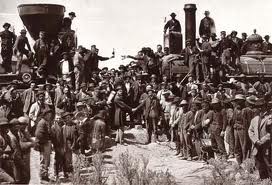
On today's date, May 10, 1869 the final touch was put on the Trans Continental Railroad at Promontory Point in Utah, and our nation was at long last linked from the West Coast to the East Coast. No longer was the bounteous land of California and the Pacific Northwest a distant Garden of Eden to be reached only after a long, arduous journey of six months or more. It was now accessible by train in a week. The United States was now a country that truly reached from sea to shining sea... the old order of things as the Alto Californian put it had indeed passed away forever.
Getting to California - Literally a Killer Commute
California and the Pacific Northwest. This ground was rich enough to grow fruits and vegetables in abundance, and lumber was in limitless forests. And GOLD had been discovered there in 1848. This had made California THE land of plenty in the United States. Thousands had set their minds and hearts upon reaching this fertile and RICH land. But how to get there? There were only three ways, and all of them were
arduous to a killer degree. One could go by boat which involved a trip from an eastern port, down around the southern tip of South America via Cape Horn, and then north up to California. Six months of tedium broken only by raging sea storms. There was the trip by sea to the Isthmus of Panama, an overland passage through a tropical mosquito infested swamp, followed by the voyage to California. Quicker, but you could die of malaria. And third was the most inhospitable choice of all: by land via wagon, or horse over one of the most arid, alkaline, godforsaken deserts on earth, followed by a trip through the Sierra Nevada Mountains which could freeze you to death. Any one of these took up to eight months and could kill you. It did in fact kill many who tried it.
A Herculean Labor and the Men Who Made it Happen
Linking this nation into one land was a Herculean labor requiring men on both ends of the work force to perform superhuman tasks. And in America we had an entrepreneurial system perfectly suited for the job. There were visionaries who saw a nation linked east to west, and surveyed land. Men like Theodore D. Judah (below), who started the
Central Pacific Railroad Co. moving east from California. Sadly, Judah died in 1863 from malaria contracted crossing the Isthmus of Panama on his way back to New York from California. There were men like Grenville M. Dodge, the hard driving Civil War General who convinced Abraham Lincoln the best route was from Omaha west to Utah. Dodge surveyed much of the route, and started the Union Pacific Co. which moved the project west from Iowa.
Dodge (right) also conducted a ruthless campaign to clear the path for the railroad of ALL Indians. There were the Big Four of the Central Pacific: Gov. Leland Stanford of California as well as Collis P. Huntington, Charles Crocker, and Mark Hopkins, who took over the C.P. after the death of Judah and arranged the financing and the government backing by means both legal and shady. And there were the workers: Chinese with the C.P.; industrious and methodical and anxious to have a stake in this profitable venture.
Irishmen and former soldiers from both sides of the Civil War working for the U.P. who knew how to take orders and work like a team. All of these were free men who worked to blast their way through mountains and across parched deserts to link this country together. They performed back-breaking labor, living under the harshest and most dangerous conditions imaginable. Freezing in the Sierra Nevada Mountains and dying of thirst in the deserts of Utah. But they all worked for pay, and took pride in what was clearly a great national enterprise.
May 10, 1869 - the Great (?) Ceremony
There was of course a great race between the Central Pacific and the Union Pacific to see who could lay the most track and therefore rake in the most profit from this great feat of engineering. But it all came to an end in May of 1869. The ceremonial hammering in of the last spikes linking the nation up at last was set for May 8, but various delays of guests arriving put it off until May 10. One of those late guests was Dr. Thomas C. Durant (below), head of the Union Pacific.* He was on his way, but was apparently kidnapped in
Piedmont, Wyoming by some of his own workers whose wages had not been payed. So Dr. Durant wired for the truant cash, and arrived by the 10'th. Gov. Stanford of the Central Pacific and Dr. Durant were to simultaneously hammer in four ceremonial spikes, two gold, one silver and a fourth made of silver, iron and gold. And once this happened, an iron spike on an adjacent tie and wired to the telegraph system was to be driven in telegraphing the news to waiting crowds across the nation. But, as it turned out, both Gov. Stanford and Dr. Durant completely missed on their first tries. But the telegraph operator sent the signal anyway, and the assembled party posed for the famous photo above.
But before all of this happened, the last of the old stage coaches brought in the last U.S. Mail Delivery to be carried thus. This was indeed placed on a Central Pacific Mail Car for delivery to the coast. And with this small gesture the real change had occurred. Time and space had been closed for all time... "the old order of things passed away forever."
* = For those of you who are fans of the series "Hell On Wheels" on the AMC TV network (as I definitely am!), yes this is indeed the character portrayed with such skill by the actor Colm Meany (below). It seems that he is portrayed on that show pretty accurately!!
Sources:
"Nothing Like It in the World" by Stephen E. Ambrose, Simon & Schuster, New York, 2000.
"The Railroaders", Time Life Books, "the Old West" Series, by Keith Wheeler and the Editors of Time Life Books, Time Life Books, New York, 1973.
+ 201.
Saturday, May 10, 2014
Friday, May 9, 2014
MAY 9 = Col. Blood Tries to Steal the Crown Jewels
"The history of the regalia would be incomplete without some short mention of Blood's desperate and impudent attempt to steal the crown, globe, and sceptre in the reign of Charles II. This villain, Blood, had been a lieutenant in Cromwell's army and had turned government spy..."
Thomas Blood and the English Civil War
First by way of brief background, this crime of Colonel Blood took place after the long and terrible English Civil War which raged between 1642 and 1651. During this conflict the Royalist forces supporting King Charles I (pictured right, reigned 1625 - 1649) fought in bloody, pitched combat against the Parliamentarians, or "Roundheads" lead primarily by Oliver Cromwell (1599 - 1658). The forces of Cromwell were called "Roundheads" because they kept their hair short in reaction against the prevailing fashion of wearing hair long and in ringlets as the Royalists did. The causes of this war were too intricate to go into here. Let it suffice to say that it had a lot to do with religion (Catholic -vs- Protestant), and the divine rights of Kings -vs - the rights of the Parliament, and whether the Parliament was legitimate. Thomas Blood lived during this time and he seems to have been rather a mercenary type of man. He started out supporting the Royalists, before switching over to the Roundheads, apparently more because he wanted to be on the winning side than out of any sense of principles. But he was also rumored to be a spy for the Royalists. Go figure!! Anyway, the war ran it's course and Charles I wound up being beheaded. He was replaced by a kind of Republic called "the Protectorate" under the personal leadership of Cromwell. This ran from 1653 to 1659 ending with the death of Oliver Cromwell and his replacement by the oldest son of Charles I, who was Charles II, who ruled in what was called "the Restoration" from 1659 until his death in 1685. Thomas Blood needless to say didn't fare so well in the Restoration. He lost most of his money and estates, and had a continuing blood feud with his longtime enemy James Butler, 1st Duke of Ormonde whom he attempted (unsuccessfully) to kidnap in 1666.
Blood Tries the Ultimate Heist...
At this time the British Crown Jewels (the Crown itself, the Orb and the Sceptre) were kept in the Tower of London under the "care" of the Master of the Jewel House, a 77 year old man, one Talbot Edwards. These pricey baubles could be viewed, apparently by anyone who payed a fee to this Mr. Edwards. During April or May of 1671, Blood made several visits to the Tower disguised as a Parson, and accompanied by a woman posing as his wife, and payed for a look at "the Regalia" as Thornbury & Wolford call it. During one such visit, Blood's "wife" feigned an illness and got Edwards to take them to his apartments in the Tower wherein Mrs. Edwards gave her some "spirits" to cure her "ailment". During subsequent visits, Blood further ingratiated himself with Edwards by bringing several pairs of white gloves to thank them for their help. Blood then offered to marry the Edward's daughter to a fictitious rich nephew of his. This was all just a ruse to get some of Blood's henchman close to the Jewels in order to grab them and be gone quickly. On today's date, May 9 Blood showed up for a dinner with his "nephew" and two of his friends and convinced Edwards to give them all a look at the Jewels, while they waited for dinner to be prepared. According to Thornbury & Walford:
"The moment the door was locked inside, according to Tower custom, the ruffians muffled and gagged the old man, and then felled him till he was nearly dead. Unluckily for the rascals, young Edwards at that moment returned from Flanders, and ran upstairs to see where his father and sister were. Blood and Parrot made off at once with the globe and the crown."
This "young Edwards" was the son of the old man, Wythe, who was returning from military service in the Netherlands and appears to have come home at this precise moment. Talk about timing!! But before young Edwards showed up, Blood and his fellow malefactors seem to have discovered that the Crown Jewels were too large to conceal on their way out of the Tower. NOT A PROBLEM!!! They just decided to bring their quarry down to size. SO..... Blood used a mallet of some sort to pound the Crown of St. Edward until it was sufficiently flat to be hidden beneath his clerical robes. One of the henchmen, Blood's brother in law, Mr. Hunt, produced a file and cut the Sceptre in half in order to fit it into his bag. Happily the other man, a Mr. Parrot, was able to conceal the Orb by stuffing it down his pants without further reducing it's girth by way of pounding, filing or other such expedients. I swear folks, these are the exact details which I've found in every account of this which I've read online. You can't make this stuff up... not believably anyway.
"Treason! Murder! The crown is stolen!"
Well upon Wythe's incredibly timely arrival, he was met at the door by one of Blood's hench- men guarding the door, who challenged him. Clearly, there was something amiss for him to be challenged at his father's doorstep, so he pushed his way past the intruder and rushed upstairs to his fathers apartment to see what was going on. The guard then alerted the thieves/vandals. And around this moment, Mr. Edwards regained consciousness, and freed himself, yelling: "Treason! Murder! The crown is stolen!" The Blood Gang then high-tailed it to their horses waiting by the gate. In their haste, they dropped the two halves of the Sceptre, and exchanged fire with some of the now alerted Tower guards. They joined in the cries of alarm attempting to confuse their pursuers, but confused themselves as much, because Blood managed to drop the crown before he reached the iron Tower gate. Blood was taken, but not easily as he struggled with his captors crying "It was a gallant attempt, however unsuccessful! It was for a crown!" Apparently to Colonel Blood, a flattened crown was still a crown.
Blood is Brought to... Justice???
Blood's henchmen were also captured but for reasons I have not been able to ascertain, they were not punished! As for Colonel Blood himself, fate was even more inscrutable. He was taken in chains before King Charles II (above), whose very own jewels he had attempted to purloin. The King asked Blood, "What if I should give you your life?" and Blood replied humbly, "I would endeavour to deserve it, Sire!" AND IT WORKED!!! Not only was Blood released with no punishment of any kind, but the King granted him estates in Ireland worth over five hundred pounds per year!! The reasons behind this extravagant act of royal clemency are unknown; His Majesty may have just been amused by the engagingly roguish nature of Blood. And there has been speculation that the King secretly arranged the whole thing himself as a way of selling off his jewels and raising some much-needed cash. As for Blood himself, he died in 1680. His epitaph reads in part:
"Here lies the man who boldly hath run through
More villainies than England ever knew;
And ne'er to any friend he had was true.
Here let him then by all unpitied lie,
And let's rejoice his time was come to die."
READERS!! If you would like to comment on this, or any "Today in History" posting, I would love to hear from you!! You can either sign up to be a member of this blog and post a comment in the space provided below, or you can simply e-mail me directly at: krustybassist@gmail.com I seem to be getting hits on this site all over the world, so please do write and let me know how you like what I'm writing (or not!)!!
Sources:
by Walter Thornbury & Edward Walford, Cassell & Company, Ltd, 1881 available online at:
http://books.google.com/books?id=KZQNAAAAIAAJ&dq=blood+atttempt+to+steal+%20crown+jewels&source=gbs_
http://en.wikipedia.org/wiki/Thomas_Blood
Wednesday, May 7, 2014
MAY 7 = "The Lusitania" is Torpedoed
"At 2:15 p.m. when ten to fifteen miles off the Old Head of Kinsale, the weather being then clear and the sea smooth, the Captain, who was on the port side of the lower bridge, heard the call, "There is a torpedo coming sir," given by the second officer. He looked to starboard and then saw a streak of in the wake of a torpedo travelling towards his ship. Immediately afterwards the "Lusitania" was struck on the starboard side somewhere between the third and fourth funnels. The blow broke number 5 lifeboat to splinters. A second torpedo was fired immediately afterwards, which also struck the ship on the starboard side. The two torpedoes struck the ship almost simultaneously."
- From the report of the Formal Investigation into the sinking of the "Lusitania" by the British Board of Trade.
On the afternoon of todays date, May 7, in 1915, the British ocean liner Lusitania was torpedoed without warning by a German submarine off the south coast of Ireland. Within 20 minutes, the vessel sank into the Celtic Sea. Out of a total compliment of 1,959 passengers and crew, 1,198 people were drowned, including 128 Americans.
Wilson Tries to Keep the U.S. Out of "the Great War"
The American government of President Woodrow Wilson (left) had throughout the years of the conflict in Europe sought to maintain a middle course between the fighting states of Europe since their war began in August of 1914. Despite heavy pressure from some in the United States, lead by former President Theodore Roosevelt who thought that America ought to enter the war on the side of the Allies, the Wilson administration held out against US intervention. Wilson believed that how ever much the American public might sympathize with the Allied powers of France and England, the citizenry of the US did not want to be dragged into what was seen as essentially a European affair. Besides, the Allied Powers also included the Czarist regime of Russia which was seen by many as being as despotic and repressive as the Imperial regimes that ruled in Germany and in her ally Austria-Hungary. And there was a considerable segment of the American public, many of them fairly recent immigrants from Germanic countries that was sympathetic to the German side. Nevertheless, the German government's declaration of unrestricted submarine warfare on all ships sailing in, and around the British Isles was taken as a direct threat to Americans and to American intersts. Great Britain was afterall one of the closest and most important trading partners with America. As a result of the german declaration, tensions were on the rise, especially when ads were taken out in US newspapers signed by the Imperial German Government warning of the danger such as this one dated April 2, 1915:
"Notice! Travellers intending to embark on the Atlantic voyage are reminded that a state of war exists between Germany and her allies and Great Britain...that the zone of war includes waters adjacent to the Britsh Isles...that vessels flying the flag of Great Britain or of any of her allies are liable to destruction in those waters and that travellers sailing in the war zone on ships of Great Britain or her allies do so at their own risk."
"The Lusitania" is Torpedoed on May 7!
In spite of ads such as the one above, Lusitania left New York on May 1 with no significant cancellations to her passenger manifest, bound for Liverpool. With such notable citizens aboard as the millionaire sportsman Alfred Gwynne Vanderbuilt, and the great Theater producer Charles Frohman, and the writer Elbert Hubbard, the passengers numbered over 1250, more than 159 of them Americans, together with over 700 crew members. When the torpedoes struck, the passengers
had just finished lunch. Actually,the torpedoing vessel German U-boat U-20 fired only one torpedo according to her Captain, Walter Schweiger. The second explosion may well have been one of Lusitania's boilers. Schweiger then recorded in his log:"Torpedo hits starboard side right behind the bridge. An unusually heavy explosion takes place with a very strong explosive cloud. The explosion of the torpedo must have been followed by a second one [boiler or coal or powder?]... The ship stops immediately and heels over to starboard very quickly, immersing simultaneously at the bow... the name Lusitania becomes visible in golden letters."
"The Lusitania" Sinks in Less Than 20 Minutes
Despite the efforts of Lusitania's very experienced captain William Thomas Turner (below) to reduce her speed and beach her, she sunk in less than 20 minutes. Over 1190 people were lost; one hundred
of those killed had been children. The sinking caused massive outrage in the Untied States. The publication "The Nation" called it "a deed for which a Hun would blush, a Turk be ashamed, and a Barbary pirate apologize." The German government claimed that the Lusitania had been carrying munitions and other materials of war. Lusitania had in fact been fitted with gun mounts, but the guns themselves had never been fitted. And she had been carrying 18 pound shrapnel shells, an estimated 4,200,000 rounds of Remington rifle cartridges and 1,250 empty shell cases. But this was part of "a general cargo of the ordinary kind" according to the Board of Trade Report. "There was no other explosive on board." President Wilson, while outraged by the sinking, still resisted entering the war as so many urged him. In a phrase which struck many as being lawyerly to a cowardly degree, he said :
"There is such a thing as a man being too proud to fight. There is such a thing as a nation being so right that it does not need to convince others by force that it is right."
Outrage Over the Sinking of "The Lusitania" Helps Lead the U.S. Into World War One
In spite of the restraint that he showed in delivering several very strongly worded notes to the German government, his Secretary of State,William Jennings Bryan resigned in protest that the reaction was overly provacative. Nevertheless, Wilson's judgement that the public, however outraged, was not yet ready for war with Germany was borne out as being essentially correct. In November of 1916, campaigning on a slogan that said "He kept us out of war!", Wilson was resoundingly re-elected to a second term. But the public appetite for such restraint had clearly begun declining since the sinking of the Lusitania, and in April of1917, barely one month after his second inaugural, Wilson asked Congress for a Declaration of War on Germany. Winston Churchill, who at the time was the First Lord of the British Admiralty, had no doubts as to the role of the sinking of the Lusitania in the march of America towards entering the war on the Allied side, in spite of President Wilson's restraint. In 1923 he wrote:
"The United States, whose citizens had perished in large numbers, was convulsed with indignation, and in all parts of the great Republic the signal for armed intervention was awaited by the strongest elements of the American people. It was not given, and the war continued in it's destructive equipoise. But henceforward the friends of the Allies in the United States were armed with a weapon against which German influence was powerless, and before which after a lamentable interval cold-hearted policy as destined to succumb."
READERS!! If you would like to comment on this, or any "Today in History" posting, I would love to hear from you!! You can either sign up to be a member of this blog and post a comment in the space provided below, or you can simply e-mail me directly at: krustybassist@gmail.com I seem to be getting hits on this site all over the world, so please do write and let me know how you like what I'm writing (or not!)!!
Sources:
"The American Heritage History of World War One" Narr. by S.L.A. Marshall, Simon & Schuster Inc., New York, 1961.
"The World Crisis - 1915" by Winston Churchill, Scribners & Sons, New York, 1923
"Shipping Casualties - Loss of the Steamship 'Lusitania'." - The Report of the Formal Investgation, HM Stationary Office, 1915.
http://www.lusitania.net/
+ 1289.
+ 1551.
+ 1112.
Tuesday, May 6, 2014
MAY 6 = "The Hindenburg" Explodes

"It burst into flames! It burst into flames, and it's falling, it's crashing! Watch it! Watch it, folks! Get out of the way! Get out of the way! Get this, Charlie! Get this, Charlie! It's fire—and it's crashing! It's crashing terrible! Oh, my, get out of the way, please! It's burning and bursting into flames, and the—and it's falling on the mooring-mast and all the folks agree that this is terrible, this is the worst of the worst catastrophes in the world. Ohhhhh! It's–it's–it's the flames…… oh, four- or five-hundred feet into the sky and it ... it's a terrific crash, ladies and gentlemen. It's smoke, and it's flames now ... and the frame is crashing to the ground, not quite to the mooring-mast. Oh, the humanity and all the passengers screaming around here!!”
{Listen to the broadcast along with newsreel footage by clicking on the highlighted words, "the frenzied broadcast.." etc. just below}
This was the frenzied broadcast of Herb Morrison (below),
an American radio reporter as he reported the explosion of "the Hindenburg", a catastrophic fire that destroyed the LZ 129 Hindenburg zeppelin 78 years ago on today’s date, May 6, in 1937 at Lakehurst, New Jersey, killing 36 people. Morrison and engineer Charlie Nielsen had been assigned by station WLS in Chicago to cover the arrival of the airship in New Jersey as an experiment in recording news for delayed broadcast. Network policy at the time forbade the use of recorded material except for sound effects on dramas, and Morrison and Nielsen had neither equipment, not facilities for live broadcast. So this broadcast did not go out onto the air live, right as it happened. Nevertheless, it was eventually played and the drama of it has caught the public in the moment of when fate took a hand in what was to have been a routine news broadcast better than anything else did until the assassination of Lee Harvey Oswald in 1963, or more recently the explosion of the space shuttle "Challenger", the events of 9/11, or the Boston Bombings.
"The Hindenburg" - the Pride of Nazi Germany
The Hindenburg was designed to be the biggest and the best – the fastest and the most luxurious flying vessel of its time. It was more than 800 feet long, had a range of 8,000 miles, could carry 97 passengers and had a state-of-the-art Mercedes-Benz engine. It was filled with 7 million cubic feet of hydrogen, even though helium was known to be far safer, because it made the flying ship more maneuverable. The Hindenburg had made crossings of the Atlantic ocean a total of ten times the year before and was held up as a symbol of the advanced state of the Nazi government in Germany; the very symbol of Aryan national pride.
"The Hindenburg" Bursts Into Flames!
Flying at a speed of 85 miles per hour, the Hindenburg was scheduled to arrive in New Jersey at 5 a.m. on May 6, but poor weather conditions delayed the arrival until the late afternoon when rain further delayed the final docking procedure. When the she was finally cleared to dock, Captain Max Pruss brought the ship in too quickly, and was obliged to order a reverse engine thrust. At 7:20 p.m., a gas leak was noticed, and within a few minutes, the tail blew up, sending flames exploding several hundred feet into the air and as well as down to the ground below. A chain reaction resulted which caused the entire vessel to blow up instantly in a truly horrific explosion. Present were over 1,000 spectators awaiting the Hindenburg's arrival, and they were able to feel
the heat from the blast from more than a mile away. Some of the passengers on the blimp tried jumping for the landing cables at the docking station but most of them missed, and perished. Other passengers tried to jump when the burning airship was closer to the ground, and these attempts at escape were more successful. Many passengers who did try this suffered broken bones from the jump. Still more passengers suffered some severe burns. As difficult as it is to imagine it, based on the film images, fifty-six people did indeed manage to survive. As a result of the very public destruction of the Hindenburg, lighter-than-air passenger travel rapidly fell out of favor in the years that followed, and no rigid airships survived World War II.
Herb Morrison After the Crash of "the Hindenburg"
As for Herb Morrison, a sort of urban legend developed that Morrison was fired by WLS for his emotional reaction, but according to the station's weekly magazine and Morrison himself, this is not true. In fact, he was highly praised by station management, and the story of how he and Nielsen made the recording was described in detail. Morrison went on to serve in the United States Army Air Forces during World War II, and later became the first news director at WTAE-TV in Pittsburgh. In the 1975 motion picture The Hindenburg, Morrison was employed as a technical adviser. He retired to live outside Morgantown, West Virginia. He was active as a lecturer to colleges and news organizations. He died in 1989.
READERS!! If you would like to comment on this, or any "Today in History" posting, I would love to hear from you!! You can either sign up to be a member of this blog and post a comment in the space provided below, or you can simply e-mail me directly at: krustybassist@gmail.com I seem to be getting hits on this site all over the world, so please do write and let me know how you like what I'm writing (or not!)!!
Sources:
http://en.wikipedia.org/wiki/Herb_Morrison
http://en.wikipedia.org/wiki/The_Hindenburg_Disaster
+ 223
+ 118.
+ 99.
Sunday, May 4, 2014
MAY 4 = The Battle of the Coral Sea
,_8_may_1942.jpg)
Above: The aircraft carrier U.S.S. Lexington explodes, 5/8/1942.
“For I dipt into the future, far as human eye could see,
Saw the Vision of the world, and all the wonder that would be;
Saw the heavens fill with commerce, argosies of magic sails,
Pilots of the purple twilight dropping down with costly bales;
Heard the heavens fill with shouting, and there rain'd a ghastly dew
From the nations' airy navies grappling in the central blue;
Far along the world-wide whisper of the south-wind rushing warm,
With the standards of the peoples plunging thro' the thunder-storm;”
- Alfred Lord Tennyson in his poem “Locksley Hall”, 1835.
No, Tennyson was not writing science fiction – that would be left to his contemporary Jules Verne who in 1869-70 wrote in “20,000 Leagues Beneath the Sea” of the fantastic idea of a ship that could operate under water! Tennyson was writing more allegorically of an idea - navies employing airplanes - which would revolutionize naval warfare in a far more distant future. And as far off as it may seem today, up until World War Two, naval battles were invariably affairs of surface ships slugging it out broadside to broadside. While all of the world powers built huge battleships to slug it out in the old way, it was naval airpower that would decide the fate of the war in the vast expanses of the South Pacific. This idea of our navy projecting power into far distant places - such as dispatching a team of Navy Seals into Osama Bin Laden's bedroom, was just about to be born in the South Pacific. Japan had struck the first blow in that battle with its attack on Pearl Harbor on Dec.7, 1941. Luckily for us, our aircraft carriers happened to be away that Sunday morning.
The Battle of the Coral Sea - May 4 - 8, 1942
And it was on today’s date, May 4 in 1942 that those carriers began sticking it to the Japanese Navy when planes from aircraft carrier USS Yorktown bombed a Japanese invasion force headed for the island of Tulagi in the Solomon Islands, opening the Battle of the Coral Sea.
This was the first naval battle ever fought in which the surface vessels never came to within sight of each other; it was fought entirely by the aircraft of the two navies. Flush with success in their early campaigns, the Japanese sought to seal off the eastern Pacific and threaten Australia, which was just to the south. Towards that end they dispatched a force with the primary objective of taking Port Moresby on New Guinea which was an important Allied base of operations. The idea for the Japanese was to take Port Moresby and use it themselves to bomb Australia as well as any other Allied operations in the area. But they got in their own way. In the words of John Winton:
“The Japanese could have assembled an invasion force, given it as strong an escort as possible and simply sent it to Port Moresby. But that was not their way. Whenever they had enough ships they over-elaborated. They split their force into separate groups with separate objectives. They laid intricate traps, involving complicated diversions, decoys and pincer movements. Japanese plans required a degree of cooperation between ships which no navy in the world has ever achieved. They made few allowances for contingencies. Most dangerous of all, they relied on the enemy doing what was expected of him.”
"Scratch One Flattop!!"
The Japanese, commanded by Vice Admiral Shigeyoshi Inouye (below) had a task force assigned to capture Port Moresby.
Another one to invade Tulagi and set up a sea plane base and for Louisades, there was the main covering group intended to protect all of these operations. This had the light carrier Shoho attached, commanded by Admiral Goto, and the striking force which had the carriers Zuikaku, and Shokaku, under Admiral Takagi. Inouye meant to squeeze the Americans in a pincer between Goto and Takagi. But the Allies had broken the Japanese naval codes and thus knew in advance that the Japanese would be attacking Port Moresby and about when. With this information, Admiral Chester Nimitz, the U.S. Naval commander in the Pacific dispatched an American /Australian naval force
built around the aircraft carriers Lexington and Yorktown
and commanded by Rear Admiral Frank Fletcher (below) into the Coral Sea, which encompassed this area, to stop them. The Tulagi force was intercepted and attacked as said on May 4. The two forces spent the next two days groping around looking for each other as if they were blind folded, depending on their scout planes to tell them where the forces were. The main engagement took place on May 6 and 7, with strikes and counter strikes being launched by both sides. Planes from the Lexington found and successfully attacked the Shoho on the 6th. With planes from the Yorktown, they hit Shoho with thirteen bombs and seven torpedoes. Lt. Commander R.E. Dixon, leading one of the attack groups radioed back “Scratch one flattop! Dixon to Carrier, scratch one flattop!”
The Japanese Sink the U.S.S. Lexington
"The Shoho" had in fact been a comparatively minor target - a light escort carrier. But Admiral Inouye had been so alarmed by her loss, that he postponed the Port Moresby landing altogether, while sending his heavy carriers to seek out and destroy the American carriers. This did indeed concentrate the Japanese forces, but their big pincer had been thrown aside, and their forces had as a result been sent to deal with the Americans on a equal footing. The Allied forces had the advantage of knowing the Japanese plans in advance and also the fact that Admiral Fletcher had been freed by Nimitz to respond as he thought necessary, unlike the Japanese who had to adhere to a rigid plan, which as with the loss of "the Shoho" had been thwarted. Nevertheless, the Americans did suffer the loss of the Lexington. Japanese Lt. Commander Shigekazu Shimakazi recalled the ferociousness of the attack:
“The carriers and their supporting ships blackened the sky with exploding shells and tracers. It seemed impossible that we could survive and torpedo runs through such incredible defences… I could see the crewmen on the ship staring at my plane as it rushed by. I don’t know that I could ever go through such horrible moments again.”
This action on May 7 and 8 had also resulted in the severe damaging of the main Japanese carriers Shokaku (pictured below,
under attack) and Zuikaku, such that they were obliged to undergo repairs which took them out of the Battle of Midway which was to come.
The Americans Triumph in the Battle of the Coral Sea.
Tactically, the Japanese could claim a victory at the Coral Sea, because they had sustained fewer losses in ships. Their big carriers had survived, whereas the Americans had lost one of theirs, "the Lexington", and the other, "the Yorktown" had been severely damaged. But she would surprise the hell out of the Japanese by being repaired in time for Midway. And strategically it was an Allied victory, because the seemingly invincible Japanese Navy had finally been stopped for the first time. In the words of John Keegan:
"The Battle of the Coral Sea electrified America. The sinking of "the Shoho" was the first success achieved by the U.S. Navy since the outbreak of the war, and while not recompense for Pearl Harbor, was sweet revenge. It demonstrated that American carrier aircraft, in particular American carrier aircrew, were the equal of their Japanese counterparts, who in the first six months of the war at sea, had won something of (a) superman reputation..."
For the long term, with the Battle of the Coral Sea an important set of first steps had been taken. The idea of military intelligence gathering had for the first time been put with the movement of military assets in order to direct a projection of Naval Power into a place far distant from the eyes of any American personnel. The idea of an American Naval Vessel firing missiles to take out a target that we knew to be far inland, or of U.S. Naval Air power doing the same thing got it's first try in the waters of the Coral Sea. And the idea of a U.S. Naval team being sent into a specific spot to take out a specific person - such as the death of Japan's Admiral Yammamoto (which would happen later in the war), or killing Osama Bin Laden just a short five years ago, stemmed from this same event.
READERS!! If you would like to comment on this, or any "Today in History" posting, I would love to hear from you!! You can either sign up to be a member of this blog and post a comment in the space provided below, or you can simply e-mail me directly at: krustybassist@gmail.com I seem to be getting hits on this site all over the world, so please do write and let me know how you like what I'm writing (or not!)!!
Sources:
"Air Power at Sea" by John Winton, Winton, Sidgwick Ltd., 1976
Sea Battles of the 20th Century
1976
"The Price of Admiralty" by John Keegan, Penguin Books, New York, 1988
http://www.history.navy.mil/photos/events/wwii-pac/coralsea/coralsea.htm
Photo:
The U.S.S. Lexington explosion =
http://en.wikipedia.org/wiki/File:Large_explosion_aboard_USS_Lexington_(CV-2),_8_may_1942.jpg
+ 644.
+ 419.
Saturday, May 3, 2014
MAY 2 = Dos de Mayo
"Most of the people had nothing other than knives and sticks... Yet despite this, blind with rage and fury, some fired on the French from windows and street corners … others flung themselves on their very ranks … and still others hurled stones, pieces of furniture and kitchen utensils from the balconies, where they were joined by women armed with cauldrons of boiling water. In short, it really seemed as if there was not a single soul who was not disposed to water the streets with French blood … even if it should be at the cost of their own."
- Jose Clemente Carnicero Torribio, Priest
On this date, May 2 in 1808, a bloody insurrection broke out in Madrid, Spain against the occupying French forces of Napoleon. The French Emperor had a very low opinion of the Spanish populace, and evidently expected them to compliantly lay down for his plans to throw out their King and place his brother on the throne of their country. But they had an even lower opinion of him and his soldiers. And like the "Allegory of the City of Madrid" by Francisco Goya above they were about to emblazon this day on his memory in a way that he would regret ever after. To use a modern allegory, Spain was about to become Napoleon's Vietnam.
The Drift to Insurrection
The royal personages ruling Spain had degenerated from the strong rulers of the days of Ferdinand and Isabella to the likes of Charles IV, who spent most of his days hunting and devoting about 30 minutes per day to governing his Empire. His wife, Maria Luisa, whom he largely ignored had taken a soldier named Manuel Godoy (below) as a lover, and she had gotten him to the
rank of her husband's Chief Minister. The last few Kings of Spain leading up to Charles III had been decent rulers who made reforms which had strengthened the rule of their family over Spain. But by 1808, Godoy, who by then was a widely despised dictator, had reduced Spain to a virtual client state to the expansionist French Emperor, linking Spain into a dubious alliance with France in her war against the established order in Europe.
But Napoleon wanted a stronger and more reliable ally to his south and also some way of muzzling Portugal, which was the last continental ally of his implacable foe, England. So Napoleon decided to push Charles IV aside in favor of his dissolute son Ferdinand (below), to whom he offered the hand in marriage of one of the princesses of his creation. Then, he could easily be forced to abdicate in favor of Napoleon's own brother, Jerome. As J. Christopher Herold has put it:
"The thought that the Spanish people might offer serious resistance never entered his head. The Spanish royal family were corrupt fools and he would trick them out of their kingdom; the Spanish people was a rabble who could be ignored."
With a mind towards setting all of this in motion, Napoleon summoned the whole worthless lot to Bayonne, a city in France near the Spanish border. But a hitch developed when Ferdinand sulkily refused to abdicate. He wanted to be King, and he wanted the wife whom Napoleon had offered.
Dos de Mayo
This was where matters stood when on May 2 -"Dos de Mayo" - 1808, a crowd had gathered at the Plaza de Oriente (below as it looks today) in front of the Royal Palace in Madrid. For some time the people of Spain had watched as thousands of French troops had poured into their country, and treated them as occupiers with arrogance and contempt. Yes, they were poor, but unlike the European peasantry with whom Napoleon had dealt before, they were free men who liked their system
and their King. The Spanish people were now seething with anger and discon- tent. They had grown tired of the despotism of Godoy, and were anxious about the fate of Ferdinand, whom they viewed as their "Prince Charming" unaware of what a shallow fool he was. Napoleon had ordered that the rest of the royal family be brought to Bayonne. So with he coaches waiting for them, the crowd became anxious. The arrival of so many French troops, the departure of their king, and his son, had left the populace stunned. So when the rumor spread among the crowd that the last of Charles's sons, the six year-old Prince Francisco was throwing a tantrum and refusing to leave, the specter of the young prince's tears drove the crowd over the boiling point, and they spontaneously attacked the French soldiers guarding the coaches. Baron Lejuene, one of the French officers describes the French reaction:
"...on May 2 our officers and men were attacked in the streets, and (Napoleon's Marshal Murat) caused the assembly to be beaten. The French garrison rushed out and attacked the rebels.The enemy had already taken possession of the arsenal, where they seized 10,000 muskets, but our musketry fire, with the discharge of grapeshot from our guns, and the charges from our cavalry, dispersed their numerous gatherings. They then
went into houses to aim at us from the windows, but our soldiers forced open the doors and 2,000 mutineers died at the point of the bayonet. The armed peasants who flocked in from the country to take part in the revolt were pursued by our cavalry, who cut down and killed a great number."
But the French gunfire only made the situation worse. Within a few short minutes the streets all over the city had filled with Spanish citizens who were confused and furious at what seemed like a French mission to mow them all down. Antonio Alcala Galiano described the action:
"I was getting dressed when my mother came in looking frightened. All she said to me were the words, ‘It has begun’. There was no need to say what it was she was talking about … In a moment, having got dressed anyhow, I was in the street … Scattered shots began to be heard in the distance … On all sides bands of people were beginning to come together, although they were armed in such a ridiculous fashion that they had to be crazy to think that they could do away with French soldiers."
But the crowd was beyond thinking at this point. Jose' Blanco White (below) described what happened when the French troops called in to quell the riots entered the city:
The French had regained control of the city by the late afternoon, but they exacted a very heavy toll from the citizenry, conducting summary executions over that night. The scar that this inflicted upon the Spanish people was extremely deep and profound. Not only did this French brutality to the common people - immortalized in the famous painting by Goya (below) - become known all over Spain. But people all over the nation began a vicious and extremely violent guerrilla war all that would go on until the French were forced to leave in 1813. But between Dos de Mayo and 1813, for five years Napoleon was forced to spend a huge amount of blood and treasure propping up his brother's regime. Like the U.S. in Vietnam, "the Spanish Ulcer" as it has been labeled wound up being a continuous drain on his men and his economy - an organized army against an unorganized yet seemingly implacable foe - which, with British Army assistance, would eventually bleed him and his empire white.
Sources:
"Peninsular Eyewitnesses: The Experience of War in Spain and Portugal 1808-1813"
by Charles Esdaile, Pen & Sword Books Ltd. South Yorkshire, 2008
"The Age of Napoleon" by J. Christopher Herold, American Heritage Inc., New York, 1963
"The Memoirs of Baron Lejeune" by Louis-François Lejeune, Longmans, Green & Co., London 1807
Thursday, May 1, 2014
MAY 1 = Osama Bin Laden is Killed
"Sometimes there is a terrifying symmetry in history...."
- Alan Palmer
"Sometimes there is a truly WONDERFUL symmetry to history. This is one such moment!!"
- Brian T. Bolten
Above are two quotes. One from a truly eminent historian; Alan Palmer. Mr. Palmer was writing in his superb book about the 1812 invasion of Russia by France, "Napoleon in Russia". He was referring to the fact that the high-water mark of the French invasion, the town of Maloyaroslavets wherein a battle took place in October of 1812 , was also the high-water mark of the Nazi invasion of 130 years later in October of 1942. The other quote comes from a far less eminent writer - myself. I was writing about how the day after the death anniversary of the foremost monster of our times, Adolf Hitler, we were celebrating the death of the foremost monster of recent years - the leader of the al Qaeda terrorist network, Osama Bin Laden. Yes, it was on today's date, May 1 in 2011 that bin Laden was gunned down by U.S. Navy Seals at about 8:00 p.m., eastern time. Five years have now passed since that important day which brought dancing in the streets across the United States. While I did not join in the dancing, I fully shared in that feeling of elation. And I still feel as if it was a truly wonderful symmetry of history to have one miserable, murdering, evil scum bag of a creature removed from the planet the very day after another.
Finding Bin Laden.......
The U.S. intelli- gence effort to determine the where- abouts of Osama bin Laden, which eventually resulted in his death, began with a fragment of information found in 2002, resulting in years of further investigation. Since Bin Laden had nearly been knocked out by earlier US missile strikes, he was known to have stopped using phones through which his location could be tracked. He instead began using couriers to keep in touch with the outside world from his compound in Abbottabad, Pakistan. By 2002 US officials had heard unsubstantiated rumors that a courier named Abu Ahmed al-Kuwaiti was in contact with Bin Laden. A 2010 wiretap of another suspect found a conversation with al-Kuwaiti. CIA operatives located al-Kuwaiti in August 2010 and followed him back to bin Laden's Abbottabad compound (pictured above). In June 2011, Pakistani officials revealed al Kuwati's real name as Ibrahim Saeed Ahmed from Pakistan's Swat Valley. He and his brother Abrar and their families were living at the compound along with Bin Laden. Of course we did not have actual photos of Bin Laden there, but the link to the courier was important, and the CIA used surveillance photos and intelligence reports to figure out the identities of the folks living at the compound to which the courier was traveling. In September 2010, the CIA concluded that the compound was custom-built to hide someone of significance, very likely bin Laden probably living there with his youngest wife.
The Raid on Bin Laden's Pakistani Compound
On April 19, 2011, a helicopter raid on the suspected compound was approved by President Obama. Due to the difficult nature of our relationship with Pakistan, and suspected ties between them and Bin Laden it was decided not to tell the Pakistani government about the raid ahead of time. The raid was originally set for April 30, but heavy cloud cover delayed it until May 1. The attack force consisted of 79 U.S. Navy Seals transported on six helicopters - Blackhawk and Chinook heavy lift helicopters. The first helicopter to enter the compound encountered difficulties which forced it to make a soft crash landing into the Compound wall, going nose-first to keep from tipping over. Nobody was injured though, and the raid went on using the other choppers as backups. The SEALs found the residents in
the compound's guest house, in the main building on the first floor , and on the second and third floors where bin Laden lived with his family. The Seals reported finding "small knots of children... on every level, including the balcony of bin Laden's room". The Courier, al-Kuwaiti was armed and a brief fire fight erupted in which he and his brother were killed. The SEALs found bin Laden on the second or third floor of the main building "wearing the local loose-fitting tunic and pants known as a 'kurta paijama' ". Bin Laden peered over the third floor ledge at our boys barreling up the stairs, and then ran back into his room as a SEAL fired a shot at him, but missed. The SEALs followed him back into his room wherein they found him shielded by two of his wives. . One of them yelled in Arabic and moved as if she were about to charge. One of the SEALs shot her in the leg, then grabbed both women and shoved them aside. A second SEAL entered the room and shot bin Laden in the chest, and then in the head with his H&K 416 with Navy M855, 5.56 mm rounds. The SEAL radioed, "For God and country—Geronimo, Geronimo, Geronimo," and then, "Geronimo E.K.I.A." (enemy killed in action). Watching the operation in the White House Situation Room (pictured below), President Obama said, "We got him."
Ordering the Raid on Osama... Good Call!!
I remain very glad that our president , Barak O'Bama ordered the action that resulted in Bin Laden's death. Whatever may have gone on by way of politicizing the event, the operation and the fact of his having ordered it are and shall remain points very much in President O'Bama's favor. It did not vote for the man, but in this particular instance he definitely did the right thing, and he has my congratulations on that fact. Yes, there were facets of the intelligence gathering that made the operation possible that occurred under George W. Bush.... without which the operation would NOT have been possible. And yes, it was the bravery, skill, and fortitude of out Navy Seal teams which actually did the job that was necessary... and it WAS necessary... not just to get even, but to dispense justice to a creature who had dodged it for so long. But the president was sticking his neck out to no small degree by ordering this action, and in my opinion, it took significant courage for him to give the order to go ahead and kill this symbol of evil in the world. In the words of Israeli Prime Minister Benjamin Netanyahu:
"Congratulations America, congratulations, Mr. President, you got Bin Laden.. good riddance!!"
READERS!! If you would like to comment on this, or any "Today in History" posting, I would love to hear from you!! You can either sign up to be a member of this blog and post a comment in the space provided below, or you can simply e-mail me directly at: krustybassist@gmail.com I seem to be getting hits on this site all over the world, so please do write and let me know how you like what I'm writing (or not!)!!
Sources:
http://en.wikipedia.org/wiki/Death_of_Osama_bin_Laden
http://www.toledoblade.com/Bin-Laden/2011/05/04/Front-page-coverage-of-bin-Laden-s-death.html
http://www.guardian.co.uk/news/blog+world/pakistan
by Alan Plamer, Running Press, 2003.
+ 468.
+ 83.
Subscribe to:
Posts (Atom)