Sunday, November 10, 2013
NOVEMBER 10 = The "Edmund Fitzgerald" Sinks
"When suppertime came the old cook came on deck sayin'...Fellas, it's too rough t'feed 'ya"......At seven p.m., a main hatchway gave in, he said.....Fellas, it's been good t'know 'ya!"......The captain wired in he had water comin' in......and the good ship and crew was in peril....And later that night when 'is lights went outta sight.....came the wreck of the Edmund Fitzgerald.
Does anyone know where the love of God goes....when the waves turn the minutes to hours?........The searchers all say they'd have made Whitefish Bay.......if they'd put fifteen more miles behind 'er, ........ They might have split up or they might capsized;.......they may have broke deep and took water,........ And all that remains is the faces and the names.......of the wives and the sons and the daughters."
- From the song "The Wreck of the Edmund Fitzgerald" by Gordon Lightfoot, released in 1976.
On todays date, November 10, in 1975 the 729-foot freighter S.S.Edmund Fitzgerald sank during a storm on Lake Superior. So named for the chairman of the Northwestern Life Insurance Co. which financed her construction, the Edmund Fitzgerald was the largest and fastest ship on the Great Lakes at the time of her launching in June of 1958. She was carrying a heavy load of iron ore pellets from Superior, Wisconsin to Detroit, Michigan and carried a crew of 29 men, under the command of Capt. Ernest Mc Sorley (right).
The ship had departed on November 9th. By early on the morning of the 10th, the Fitzgerald had entered a storm that was producing gale-force winds of over 60 MPH, and waves over 15 feet high, By around 2:00 a.m., another ship, the S.S. Arthur Anderson was near enough that her captain, Jessie Cooper, could see Fitzgerald about 15 miles away from him. The two captains discussed the storm's power, and elected to alter course and head for the Canadian shore and the safety of Whitefish Bay - on the Canadian/ Michigan boarder where they would find shelter from the high winds. But the passage was proving too much for the Fitzgerald. At 3:30 a.m., Capt. Mc Sorley radioed Capt. Cooper that Fitzgerald was damaged, and listing to one side. By 4:10, a.m. the radar systems on board the Fitzgerald failed as did those at Whitefish Bay, leaving her traveling blind, but for assistance from the Anderson. At 7:10 a.m., the Anderson radioed to the Fitzgerald to ask about her condition. "We're holding our own." came the reply. It was the last word to be received from the damaged vessel. At 7:15, the S.S. Edmund Fitzgerald disappeared from the S.S. Anderson's radar view in an area of heavy rain and was not seen again. A search was launched, but no survivors were found. On November 17th, the wreck was located just 17 miles from Whitefish Bay beneath 530 feet of water. All of the 29 crew
were lost. The Coast Guard concluded that the ship was sunk when water from the heavy storm waves flooded her compartments through loose hatch covers. But the finding is disputed by many who are familiar with the wreck. One theory, supported by Capt. Cooper of the "Anderson" is that Fitzgerald likely touched rocks in a shoal area causing damage to her bottom, causing her to taking in water and slowly sink despite having her ballast pumps in full operation.
Gordon Lightfoot Immortalizes the Loss of the Fitzgerald in Song
Not long after the sinking, singer Gordon Lightfoot read about the tragedy, and was moved to write a song about it as a memorial to the men who were lost - part of which is quoted above. The song rose to great popularity, ultimately becoming a Top Ten hit on the song charts. This writer can remember the song being played on radio regularly during the '70's. The tale it told was one of the things that got me so interested in history - and the stories it tells. One of the "wives and the sons and the daughters" of whom the song spoke was Pam Johnson, daughter of Robert C. Rafferty, who was steward on the Fitzgerald when she was lost. Mrs. Johnson, when asked why the wreck of the Fitzgerald stands out among all of the other wrecks on the Great Lakes said: "The wreck stands out most because of Gordon Lightfoot's song." Thus, we have another example to go with the bombing of Guernica during the Spanish Civil War (painted by Picasso, TIH April 26) and the Mutiny on the HMS Bounty (filmed by three different directors, TIH April 28) - of a moment in history that would quite likely be a little-known footnote being brought into fore of popular memory by an artistic portrayal.
For more about the storms and gales of the month of November please log onto "Today in History's" annex or sister site (cleverly named "Today in History II") to read about "The Storms of November", an article which I previously had published on "Suite 101" but which they dropped from their exalted roles for reasons which remain as mysterious as the gales of November....
The web address for the specific article is:
http://todaysstoryinhistory.blogspot.com/2012/05/storms-of-november.html
READERS!! If you would like to comment on this, or any "Today in History" posting, I would love to hear from you!! You can either sign up to be a member of this blog and post a comment in the space provided below, or you can simply e-mail me directly at: krustybassist@gmail.com I seem to be getting hits on this site all over the world, so please do write and let me know how you like what I'm writing (or not!)!!
Sources:
"Marine Casualty Report - S.S. Edmund Fitzgerald Sinking in Lake Superior"- U.S. Coast Guard Marine Board of Investigation Report Report No. USCG 16732/64216
"Edmund Fitzgerald Fact Sheet" - U.S. Army Corps of Engineers U.S. Government Printing Office: 1991-545-160.
"The Edmund Fitzgerald: the Song of the Bell" by Kathy-Jo Wargin, Sleeping Bear Press, Chelsea, Michigan, 2003.
"Gordon Lightfoot Complete Greatest Hits" by Gordon Lightfoot; Audio CD
+ 3733.
+ 1827.
Saturday, November 9, 2013
NOVEMBER 9 - "Kristallnacht"
"At 9:30 A.M. the bell at the main gate rang persistently. I opened the door: about 50 men stormed into the house, many of them with their coat or jacket collars turned up. At first they rushed into the dining room, which fortunately was empty, and there they began their work of destruction, which was carried out with the utmost precision. The frightened and fearful cries of the children resounded through the building."
This was the recollection of one Yitzhak S. Herz of this night of Nov.9 in 1938 - which has come to be known as "Kristallnacht" (literally "Crystal Night") or"Night of the Broken Glass". It was an evening wherein a massive government organized pogrom (Anti-Jewish riot) was conducted throughout Germany and parts of Austria. It was a night in which Jewish homes, businesses, and Synagogues were vandalized, and destroyed. And this meant the shattering of countless glass storefronts like the one pictured above. It was a clear and unmistakable expression of the deeply and viciously anti-Semitic nature of the Nazi regime in Germany. Herr Herz witnessed the night at the Dinslaken Orphanage in the city of Dinslaken, which is not far from Dusseldorf in western Germany. His account recalls the active participation of the local police when he attempted to go to the town hall for help:
"About ten policemen were stationed here, reason enough for a sensation-seeking mob to await the next development. This was not very long in coming; the senior police officer, Freihahn, shouted at us: "Jews do not get protection from us! Vacate the area together with your children as quickly as possible! Freihahn then drove all of us to the wet lawn of the orphanage garden. He gave us strict orders not to leave the place under any circumstances."
As he watched, he witnessed the total destruction of the orphanage:
"Facing the back of the building, we were able to watch how everything in the house was being systematically destroyed under the supervision of the men of law and order - the police. At short intervals we could hear the crunching of glass or the hammering against wood as windows and doors were broken. Books, chairs, beds, tables, linen, chests, parts of a piano, a radiogram, and maps were thrown through apertures in the wall, which, a short while ago, had been windows or doors."
A Synagogue is Burned
Michael Bruce, a non-Jewish English- man witnessed the destruct- ion of a Synagogue by a wild mob:
"Hurriedly we went out into the street. It was crowded with people, all hurrying towards a nearby synagogue, shouting and gesticulating angrily. We followed. As we reached the synagogue and halted, silent and angry, on the fringe of the mob, flames began to rise from one end of the building. It was the signal for a wild cheer. The crowd surged forward and greedy hands tore seats and woodwork from the building to feed the flames.
"Behind us we heard more shouts. Turning, we saw a section of the mob start off along the road towards Israel's store where, during the day, piles of granite cubes, ostensibly for repairing the roads, had been heaped. Youths, men and women, howling deliriously, hurled the blocks through the windows and at the closed doors. In a few minutes the doors gave way and the mob, shouting and fighting, surged inside to pillage and loot.
"By now the streets were a chaos of screaming bloodthirsty people lusting for Jewish bodies. We hurried after them in time to see one of the foulest exhibitions of bestiality I have ever witnessed. The object of the mob's hate was a hospital for sick Jewish children, many of them cripples or consumptives. In minutes the windows had been smashed and the doors forced. When we arrived, the swine were driving the wee mites out over the broken glass, bare-footed and wearing nothing but their nightshirts. The nurses, doctors, and attendants were being kicked and beaten by the mob leaders, most of whom were women."
World Reaction: Shock. Local Reaction: Passive.
In his history of this period, "The Rise and Fall of the Third Reich" William L. Shirer who was an eyewitness to the events of this night wrote of the reaction of the world to these events, and also the
reaction of many Germans:
"World opinion was shocked and revolted by such barbarity in a nation which boasted a centuries-old Christian and humanist culture. Hitler, in turn was enraged by by world reaction and convinced himself that it merely proved the power and scope of "the world Jewish conspiracy.
"Hitler's sickness was contagious; the nation was catching it, as if it were a virus. Individually, as this writer can testify from personal experience, many Germans were as horrified by the Nov. 9 inferno as were Americans and Englishmen and other foreigners. But neither the leaders of the Christian churches, nor the generals, nor any other representatives of the "good" Germany spoke out at once in open protest. They bowed to what General von Fritsch called "the inevitable" or "Germany's destiny."
91 Jews were killed during this night of terror, and another 30,000 were arrested and sent into concentration camps. In addition to the countless Jewish homes, schools and hospitals that were smashed and destroyed, about 7,000 businesses and 1,000 synagogues were demolished.
Sources:
"The Rise and Fall of the Third Reich" by William L. Shirer, Simon & Schuster, New York, 1960.
http://motlc.wiesenthal.com/site/pp.asp?c=gvKVLcMVIuG&b=394831
http://en.wikipedia.org/wiki/Kristallnacht
NOVEMBER 9 = Einstein's Brain....

{The above image can be enlarged somewhat by clicking on the picture}
Albert Einstein was without a doubt one of the most brilliant men who ever lived. But his brain was obviously somewhere in another universe! Certainly his contributions to the field of theoretical physics are beyond measure - indeed they are the stuff of legend. His special and general theories of relativity, his founding of relativistic cosmology, his prediction of the deflection of light by gravity, and his 1921 Nobel Prize in Physics for his discovery of the law of the photoelectric effect are all accomplishments that contribute to his citation by many as the father of modern physics. But he was a man of humor, a lover of music, and a very gentle man. In fact he was a pacifist. A man possessed of brilliant intellect, and remarkable powers of perception. Nevertheless, he was a typical scientist - while he definitely had very strongly held beliefs on war versus peace, and science and it's place in the modern world, he still had his head firmly in his books and his theories. And not surprisingly, when his world was catching fire around him, while his country of Germany was being swallowed by the conflagration of World War One and its disastrous aftermath he seems to have barely even noticed.
World War One Tears the World Apart
World War One, as will shortly be discussed, was a huge tear in the fabric of civilization as the world had come to know it. Its effects were particularly bad on Germany. Although Einstein had spent much of his early adult life in Switzerland where he worked at the Swiss Patent Office, he had in fact been born in the Kingdom of Wurttemberg, part of the German Empire. And he spent the years of World War One inside Germany. By November of 1918, the tide had clearly turned against the German Empire. Despite having forced the Russians out of the war a year earlier, the Declaration of War by America against Germany and her Allies in April of 1917 had clearly put the momentum behind the Allied cause. The nations of France and England, who had been nearly exhausted by more than four years of continuous bloody warfare now joined with America, and they were closing in on Germany itself. The officers of the German General Staff, seeing that the territorial integrity of Germany was being threatened convinced the Kaiser, Wilhelm II, who by that time had been reduced to a mere figurehead anyway that he would have to abdicate. He did so on November 9 of 1918.
Einstein Seems to Barely Notice All of the Fuss.......
There was great agitation on the campuses of Germany with soldiers and workers councils advocating radical change. This was very evident on the Campus of the University of Berlin wherein Einstein was scheduled to lecture on relativity. Later on in that very week, he would meet with the head of Germany's interim government to effect the release of several of the University professors who had been detained by revolutionary students. He would go on to declare before before a crowd of over one thousand people that "all true democrats must stand guard lest the old class tyranny of the right be replaced by a class tyranny of the left". But on that particular day, Nov. 9 , with the world turned upside down and the University closed, he took little apparent notice of all of the turmoil. Quite laconically in his lecture notes (visible on the above image, about half-way down on the left hand column next to where he has wrtten "9 XI"), amongst all of his mathematical equations he wrote "fiel aus wegen revolution." Classes had been "cancelled due to revolution."
READERS!! If you would like to comment on this, or any "Today in History" posting, I would love to hear from you!! You can either sign up to be a member of this blog and post a comment in the space provided below, or you can simply e-mail me directly at: krustybassist@gmail.com I seem to be getting hits on this site all over the world, so please do write and let me know how you like what I'm writing (or not!)!!
Sources:
Albert Einstein: Creator and Rebel
Penguin Books Inc., New York, 1972 pp. 135 - 137.
http://media.caltech.edu/press_releases/12272
http://www.alberteinstein.info/gallery/images/03-009p04lrz.jpg
http://en.wikipedia.org/wiki/Einstein
+ 219.
+ 114.
Wednesday, November 6, 2013
NOVEMBER 6 = Modell's Sucker Punch
Art Modell, 1925 - 2012.
"The evil that men do lives after them.
The good is oft interred with their bones.
So let it be with Caeser."
- "Julius Caeser" Act III, Scene Two
by William Shakespeare
"We are not moving to Baltimore. In fact, we are trying to move back to Cleveland", says Cleveland Brown, a Cleveland native whose father, grandfather and great-grandfather were also named Cleveland Brown, and whose 13-year-old son is named Cleveland Brown as well. The 38-year-old nuclear medicine technician now lives in Middletown, Ohio. "And no," he says, "my son and I are not changing our names to Baltimore Browns, though I get asked that 14 times a day.....I'm not much of a football fan," says Brown, "but when the Browns said they were moving, it really affected me. Not because of my name, but because for 50 years support for that team by the people has been phenomenal." And that, of course, is what makes this particular move so extraordinary. And so extraordinarily sad."
- Steve Rushin in "Sports Illustrated", Dec. 4, 1995.
It was a black day in the fine city of Cleveland on that date - November 6, 1995. And surely it was one of the darkest days in the Hall of Shame for pro sports. For this was the day on which Art Modell, the owner of one of the proudest, and finest franchises in the history of the National Football League (NFL) announced that he was packing up "his" team and leaving the fans who had so loyally supported their team for 50 years. Never mind the fans who had grown up with the team. Never mind that this was one city which clearly and unequivocally had shown their support for this team for year after year. And some of those years had been pretty lean. No, Mr. Modell had gotten a better deal elsewhere, and he was leaving.
Modell's Double Dealing
Modell claimed that the financial situation in which he found the Browns left him no choice but to move his team. He pointed out that the Browns were $40 million in debt and that he personally had loaned the team $10 million. How could this be? How could a team that had sold 80% or better capacity of it's seats all but four times between '76 and '94(selling 89% or better in eleven of those years including ALL of years from '88 onward) be in such a state of indebtedness? The answer to that was in Modell's own blown financial dealings. Modell bought 51% of the team in 1961. In 1973, seeing that the city of Cleveland was losing money on its operation of Cleveland Stadium, he signed a 25 year lease of the stadium with the city, which gave him the rights to rent the stadium to both the Browns and the Indians - Cleveland's pro baseball franchise. In return, he would receive all the revenue that the stadium would generate including signage, parking and concession sales. In return, he would pay $150,000 per year for the first five years of the deal, and $200,000 thereafter. This was such an excellent deal for himself Modell thought, that he formed a separate stadium company, which he kept mostly for himself, and not for his partners in operating for the Browns.
Modell's Double Dealing
Modell claimed that the financial situation in which he found the Browns left him no choice but to move his team. He pointed out that the Browns were $40 million in debt and that he personally had loaned the team $10 million. How could this be? How could a team that had sold 80% or better capacity of it's seats all but four times between '76 and '94(selling 89% or better in eleven of those years including ALL of years from '88 onward) be in such a state of indebtedness? The answer to that was in Modell's own blown financial dealings. Modell bought 51% of the team in 1961. In 1973, seeing that the city of Cleveland was losing money on its operation of Cleveland Stadium, he signed a 25 year lease of the stadium with the city, which gave him the rights to rent the stadium to both the Browns and the Indians - Cleveland's pro baseball franchise. In return, he would receive all the revenue that the stadium would generate including signage, parking and concession sales. In return, he would pay $150,000 per year for the first five years of the deal, and $200,000 thereafter. This was such an excellent deal for himself Modell thought, that he formed a separate stadium company, which he kept mostly for himself, and not for his partners in operating for the Browns.
Modell's Double Dealing Starts to Come Home to Roost
But when he woke up, and found himself operating a 43 year-old stadium with many structural problems, the deal proved to be not so excellent. Structural beams that had eroded with age threw a monkey-wrench into Modell's plans to install luxury boxes, new locker rooms for the visiting teams, new restrooms and a big new modern scoreboard. He had to borrow $10 million just to fulfill these commitments to begin with. With the Indians drawing so poorly at that time, debts to the team, AND to Modell's private stadium company began to snowball. He then tried to sell his fellow operators of the Browns on buying the stadium from him. This would have produced $4.8 million for Modell, and relieved him of his debt while transferring the debt to the Browns. But that deal was squelched by by Robert Gries, who owning 43% of the Browns didn't like the idea of their being saddled with Modell's debt. Modell it turned out, had purchased property in Strongsville, Ohio upon which he had hoped to build a new stadium, and which he had greatly overvalued. This would have been a part of the stadium company which Modell proposed to sell to the Browns. It took four years, but Gries prevailed in court.
Modell to Cleveland: "I'm Outta Here!!"
So, as a result of Modell's faulty business judgement, the city of Cleveland was deprived of it's team and a considerable portion of it's heart on this dark day back in '95. Nevermind that the voters of the city had approved the funds to build a new stadium, just a short time from this whole wretched business. Baltimore offered more monetary sweetness, and Modell just booked. But there is a happy ending - the city of Cleveland was given an NFL expansion franchise in 1999, and retained the use of the Browns name and logos. It has been an uphill climb for the Browns, and continues to be to this day. But this writer, a life-long Bengals fan is very pleased to see them reoccupying their rightful and cherished place in the NFL, and looks forward to a renewal of their rivalry. And the best of all parts of the happy ending: Art Modell never again set foot in Cleveland.
EPILOGUE:
The Baltimore Ravens managed to prosper on the football field, winning Superbowl XXXV following the 2000 NFL season after which Modell handed day to day operations over to his son David. But Modell just couldn't make ends meet. So he was obliged by the NFL to sell the franchise in 2003. He died of natural causes on June 6, 2012. And on that point, I shall leave the last word to Marc Antony whom I quoted via the Bard at the beginning of this posting.
READERS!! If you would like to comment on this, or any "Today in History" posting, I would love to hear from you!! You can either sign up to be a member of this blog and post a comment in the space provided below, or you can simply e-mail me directly at: krustybassist@gmail.com I seem to be getting hits on this site all over the world, so please do write and let me know how you like what I'm writing (or not!)!!
Sources:
Tuesday, November 5, 2013
NOVEMBER 5 = Election DAAAZE!!!
Well I feel that I would be terribly remiss in my duty as an historian if I were to completely ignore the fact that this is that election time of year! I will just give a brief little run-down of three races that happened on today's date, November 5 in the past, to remember as you leave the voting booth for another year or two....
1872 = Ulysses S. Grant -VS- Horace Greeley
In 1872, the Republicans re-nominated President Ulysses S. Grant for President. Grant's administration had been plagued by charges of corruption, and many of these charges were true although Grant himself was an honest man. The decisiveness that served him so well as the commanding general of the Army of the Potomac during the Civil War deserted him in his Presidency, as he appointed many men who were incompetent, or crooked, and then stood by them for too long. But still he was very popular as the man who defeated the Confederacy. His opponent was the celebrated journalist and U.S. Representative from New York, Horace Greeley. Greeley (below) is described thus by
writer Paul J. Boller Jr.: "Greeley, for all his intelligence, sincerity, idealism, and journalistic aplomb, was erratic, crotchety, unpredictable, and thoroughly incompetent in the art of politics." On election day, today's date in 1872, at which time my great grandmother, Sarona Cooper, whom we called "Mimma" was two years old, the famous suffragette, Susan B. Anthony took the liberty of voting, for which offense she was arrested on November 18. She would be fined $100.00. "I will never pay a dollar of your unjust penalty." she said. She never did. The government dropped the case. Women were given the right to vote in 1920, an activity in which my great grandmother would take quite an interest. Grant wound up easily winning the election with nearly 56% of the popular vote. Greeley died on November 29 of that same year, well after the election, but before the Electoral College met. Therefore, Greeley's rivals on his side took the liberty of dividing his electoral votes among themselves, making Greeley's posthumous defeat even worse.
1912 = Woodrow Wilson -vs- Theodore Roosevelt & President W.H. Taft
This election was a huge win for the Democratic Nominee, New Jersey Governor, and former Princeton University President Woodrow Wilson. This was mainly because of a rancorous split in the Republican party. William Howard Taft, was elected President in 1908 with the blessing and support of his predecessor, the irrepressible Theodore Roosevelt. T.R. could easily have been re-elected himself that year, but the two-term tradition of
U.S. Presidents was established, and he rashly promised early in his second term to respect that tradition. In those days, a promise was a promise, so T.R. gave way to his old friend, the jolly and rotund William Howard Taft. But T.R. had been a burr under the saddle of the Republican establishment with his reforming, progressive policies, so they were only too happy to be rid of him. And when Taft proved to be too accommodating to the establishment, T.R. publicly broke with his (former) friend and tried to unseat him by running for the
Republican nomination himself. When the party bosses clamped down and denied him the nomination, T.R. bolted the party, and accepted the nomination of the Progressive Party. Needless to say, this split in the G.O.P. gave the election on today's date in 1912 to Wilson, who tallied 41.8% of the vote to 27.4% for Roosevelt. Poor Taft came in a distant third with 23.2%. It was a terrible defeat for T.R. who never again regained the Presidency which he had so loved. The Progressive Party had been nick-named
the "Bull Moose" Party in honor of T.R.'s hard-driving image. After the election a cartoon showing a large, exhausted, and cracked egg with the face of Roosevelt was published along with the taunting rhyme: "Humpty Dumpty sat on the wall/ Humpty Dumpty had a bad fall/ All the ex-bosses/ And Bully Moose Men/ Can never put Humpty up again."
"Click" on the image to enlarge.
1940 = Franklin D. Roosevelt -vs- Wendell Willkie
In 1940, the whole world seemed to be catching fire around an America which up to that point had been desperately trying to stay out of the war in Europe. But by election day of that year, today's date, most of Europe had been overrun by the forces of Adolf Hitler's Nazis. The Battle of Britain was in full swing as Hitler's air forces tried to bomb England into submission. The democratic nominee, President Franklin D. Roosevelt who had already served two terms was breaking a two-term tradition in a way that his relative, Theodore Roosevelt (who was the Uncle of FDR's wife, Elanor) had been unable to try. FDR said that with the world closing in on the U.S. like it was in a way that would probably involve America, it was his duty to stay on. His opponent was a maverick businessman (ala Donald Trump??) named Wendell Willkie (below) who managed to outmaneuver Senator Robert A. Taft (the son of William Howard Taft)
and New York Governor Thomas Dewey and pick up the Republican nomination. Although Willkie was nearly identical to FDR in his attitude towards the war raging in Europe, Republicans damned Roosevelt for his economic policies. My great grandmother who was now an active Republican stalwart (now you know where I get it!) ran, I am told, one of those homes wherein the very mention of the word "Roosevelt" would get the speaker soap in his mouth. And this was what Willkie attacked Roosevelt for. But it didn't work. FDR carried 54.8% of the popular vote that year, gaining that unprecedented third term. My great grandmother lived until she was 99, passing away in 1969 when I was nine years old. Franklin Roosevelt would be elected to a fourth term in 1944, before succumbing to a stroke in April of 1945. Wendell Willkie would die in 1944. But one small fragment of his spirited 1940 campaign has survived. It is the "1940 Psalm" which sarcastically sums up how the opposition felt about FDR's economic policies:
"Mr. Roosevelt is my Shepherd, I am in want.
He maketh me lie down on park benches
He leadeth me beside still factories.
He leadeth me in the path of destructionfor the New Deal's sake.
Yea, tho I walk through the valleyof depression, I anticipate no recovery, for he is with me.
His policies and diplomacies they frighten me.
He prepareth a reduction in my salary.
And in the presence of my enemies,he anointed my small income with taxes.
My expenses runneth over.
Truly unemployment shall follow all the days of my life.
And I shall live in a mortgaged homefor ever".
Sources:
"Presidential Campaigns" by Paul F. Boller Jr., Oxford University Press, New York, 1984
"The Life and Times of Teddy Roosevelt" by Stefan Lorant, Doubleday & Co., Garden City, N.Y., 1959
+ 66.
1872 = Ulysses S. Grant -VS- Horace Greeley
In 1872, the Republicans re-nominated President Ulysses S. Grant for President. Grant's administration had been plagued by charges of corruption, and many of these charges were true although Grant himself was an honest man. The decisiveness that served him so well as the commanding general of the Army of the Potomac during the Civil War deserted him in his Presidency, as he appointed many men who were incompetent, or crooked, and then stood by them for too long. But still he was very popular as the man who defeated the Confederacy. His opponent was the celebrated journalist and U.S. Representative from New York, Horace Greeley. Greeley (below) is described thus by
writer Paul J. Boller Jr.: "Greeley, for all his intelligence, sincerity, idealism, and journalistic aplomb, was erratic, crotchety, unpredictable, and thoroughly incompetent in the art of politics." On election day, today's date in 1872, at which time my great grandmother, Sarona Cooper, whom we called "Mimma" was two years old, the famous suffragette, Susan B. Anthony took the liberty of voting, for which offense she was arrested on November 18. She would be fined $100.00. "I will never pay a dollar of your unjust penalty." she said. She never did. The government dropped the case. Women were given the right to vote in 1920, an activity in which my great grandmother would take quite an interest. Grant wound up easily winning the election with nearly 56% of the popular vote. Greeley died on November 29 of that same year, well after the election, but before the Electoral College met. Therefore, Greeley's rivals on his side took the liberty of dividing his electoral votes among themselves, making Greeley's posthumous defeat even worse.
1912 = Woodrow Wilson -vs- Theodore Roosevelt & President W.H. Taft
This election was a huge win for the Democratic Nominee, New Jersey Governor, and former Princeton University President Woodrow Wilson. This was mainly because of a rancorous split in the Republican party. William Howard Taft, was elected President in 1908 with the blessing and support of his predecessor, the irrepressible Theodore Roosevelt. T.R. could easily have been re-elected himself that year, but the two-term tradition of
U.S. Presidents was established, and he rashly promised early in his second term to respect that tradition. In those days, a promise was a promise, so T.R. gave way to his old friend, the jolly and rotund William Howard Taft. But T.R. had been a burr under the saddle of the Republican establishment with his reforming, progressive policies, so they were only too happy to be rid of him. And when Taft proved to be too accommodating to the establishment, T.R. publicly broke with his (former) friend and tried to unseat him by running for the
Republican nomination himself. When the party bosses clamped down and denied him the nomination, T.R. bolted the party, and accepted the nomination of the Progressive Party. Needless to say, this split in the G.O.P. gave the election on today's date in 1912 to Wilson, who tallied 41.8% of the vote to 27.4% for Roosevelt. Poor Taft came in a distant third with 23.2%. It was a terrible defeat for T.R. who never again regained the Presidency which he had so loved. The Progressive Party had been nick-named
the "Bull Moose" Party in honor of T.R.'s hard-driving image. After the election a cartoon showing a large, exhausted, and cracked egg with the face of Roosevelt was published along with the taunting rhyme: "Humpty Dumpty sat on the wall/ Humpty Dumpty had a bad fall/ All the ex-bosses/ And Bully Moose Men/ Can never put Humpty up again."
"Click" on the image to enlarge.
1940 = Franklin D. Roosevelt -vs- Wendell Willkie
In 1940, the whole world seemed to be catching fire around an America which up to that point had been desperately trying to stay out of the war in Europe. But by election day of that year, today's date, most of Europe had been overrun by the forces of Adolf Hitler's Nazis. The Battle of Britain was in full swing as Hitler's air forces tried to bomb England into submission. The democratic nominee, President Franklin D. Roosevelt who had already served two terms was breaking a two-term tradition in a way that his relative, Theodore Roosevelt (who was the Uncle of FDR's wife, Elanor) had been unable to try. FDR said that with the world closing in on the U.S. like it was in a way that would probably involve America, it was his duty to stay on. His opponent was a maverick businessman (ala Donald Trump??) named Wendell Willkie (below) who managed to outmaneuver Senator Robert A. Taft (the son of William Howard Taft)
and New York Governor Thomas Dewey and pick up the Republican nomination. Although Willkie was nearly identical to FDR in his attitude towards the war raging in Europe, Republicans damned Roosevelt for his economic policies. My great grandmother who was now an active Republican stalwart (now you know where I get it!) ran, I am told, one of those homes wherein the very mention of the word "Roosevelt" would get the speaker soap in his mouth. And this was what Willkie attacked Roosevelt for. But it didn't work. FDR carried 54.8% of the popular vote that year, gaining that unprecedented third term. My great grandmother lived until she was 99, passing away in 1969 when I was nine years old. Franklin Roosevelt would be elected to a fourth term in 1944, before succumbing to a stroke in April of 1945. Wendell Willkie would die in 1944. But one small fragment of his spirited 1940 campaign has survived. It is the "1940 Psalm" which sarcastically sums up how the opposition felt about FDR's economic policies:
"Mr. Roosevelt is my Shepherd, I am in want.
He maketh me lie down on park benches
He leadeth me beside still factories.
He leadeth me in the path of destruction
Yea, tho I walk through the valley
His policies and diplomacies they frighten me.
He prepareth a reduction in my salary.
And in the presence of my enemies,
My expenses runneth over.
Truly unemployment shall follow all the days of my life.
And I shall live in a mortgaged home
Sources:
"Presidential Campaigns" by Paul F. Boller Jr., Oxford University Press, New York, 1984
"The Life and Times of Teddy Roosevelt" by Stefan Lorant, Doubleday & Co., Garden City, N.Y., 1959
+ 66.
Monday, November 4, 2013
NOVEMBER 4 = "CATS" Author Wins Nobel Prize
"I have a Gumbie Cat in mind.
Her name is Jennyanydots.
Her coat is of the tabby kind with tiger stripes and leopard spots.
All day she sits beneath the stairs or on the steps or on the mat.
She sits and sits and sits and that's what makes a gumbie cat."
- from "Old Possums Book of Practical Cats", by T.S. Eliot.
On today's date, November 4 in 1948, T.S. (Thomas Stearns) Eliot was awarded the Nobel Prize for Literature for the exceptional contribution that he had made to the world of poetry in the 20'th Century. Eliot was a man of extraordinary literary gifts, and even though he did not consider himself to be a terribly prolific writer, his effect on the direction of poetic verse in the 20'th Century was profound. But it was as the author of the above quoted and pictured book of verses that his work came to the ears of the late 20'th Century reader, and Broadway Music lover (although I'm not at all certain that most people are aware of that fact), and it was almost how he came to MY eyes.
The Life and Work of T.S. Eliot
Eliot was born in St. Louis, Missouri, to a prominent family. His grandfather, his father, and his mother were all leading citizens in the cultural and business world of St. Louis. Eliot took an undergraduate degree at Harvard, studied at the Sorbonne, returned to Harvard to learn Sanskrit, and then studied at Oxford. He became lifelong friends with fellow poet Ezra Pound and later moved permanently to England. In 1915, he married Vivian Haigh-Wood, but the marriage was unhappy, partly due to her mental instability, and partly because Eliot suspected that she had had an affair with the philosopher Bertrand Russell. Writing privately in his sixties, Eliot confessed:
"I came to persuade myself that I was in love with Vivienne simply because I wanted to burn my boats and commit myself to staying in England. And she persuaded herself (also under the influence of [Ezra] Pound) that she would save the poet by keeping him in England. To her, the marriage brought no happiness. To me, it brought the state of mind out of which came 'The Waste Land'."
Eliot began working at Lloyd's Bank in 1917, writing reviews and essays on the side. He founded a critical quarterly, Criterion, and quietly developed a new style of poetry. His first major work, "The Love Song of J. Alfred Prufrock", was published in 1917 and hailed as the invention of a new kind of poetry. His long, fragmented images and use of blank verse influenced nearly all future poets, as did his masterpiece "The Waste Land", published in 1922. While Eliot is best known for revolutionizing modern poetry, his literary criticism and plays were successful as well, his play, "the Cocktail Party" for example being produced on Broadway and winning the 1950 Tony Award for Best Play of the Year. Eliot had indeed become a British citizen though, having been granted that status in 1927. On January 10, 1957, Eliot at the age of 68 married Esmé Valerie Fletcher, who was 32. In contrast to his first marriage, Eliot knew Fletcher well, as she had been his secretary at Faber since August 1949. But he had been a heavy smoker all of his life, and this eventually took him. Eliot died of emphysema in London on January 4, 1965.
"Old Possum's Book of Practical Cats"
In 1930, Eliot published a book of light, almost child-like verses. Taking Ezra Pound's nickname for himself, Eliot titled the book "Old Possum's Book of Practical Cats" In 1954, the composer Alan Rawsthorne set six of the poems for speaker and orchestra, in a work entitled "Practical Cats". After Eliot's death, the book was adapted as the basis of the musical, "Cats", by Andrew Lloyd Webber, first produced in London's West End in 1981 and opening on Broadway the following year. "Cats" became the second longest-running show in Broadway history (running until 2000), and the fourth longest-running West End musical. It has been performed around the world many times and has been translated into more than 20 languages.
It was in this way, I think, that I became familiar with the work of Eliot. I was at the home of one of my high school friends, Glenn Pepple. I had been there with our mutual friend, the artist Jon Jay Muth, and we were both having a look at a few of Glenn's books. We ran across a collection of poems by this man, T.S. Eliot, of whom I had never heard before. Whether Glenn had purchased the book in reaction to the fame of "Cats", I don't know. But I found the Cat poems in the book and began reading some of them to Jay. I don't recall whether or not Jay was already familiar with them, but they were quite new to me. I was instantly captivated by these charming verses, and have remained so ever since (which is odd, since I have always been a dog owner). My favorite poem was always "Growltigers Last Stand". But the poems "Rum Tum Tugger" and "Jellicles" were also much enjoyed by me and the countless people to whom I've presented this fun collection as a gift over the years. And of course there is "The Old Gumbie Cat":
"I have a Gumbie Cat in mind, her name is Jennyanydots;
Her coat is of the tabby kind, with tiger stripes and leopard
spots.
All day she sits upon the stair or on the steps or on the mat;
She sits and sits and sits and sits--and that's what makes a
Gumbie Cat!
But when the day's hustle and bustle is done,
Then the Gumbie Cat's work is but hardly begun.
And when all the family's in bed and asleep,
She tucks up her skirts to the basement to creep.
She is deeply concerned with the ways of the mice
Their behaviour's not good and their manners not nice;
So when she has got them lined up on the matting,
She teachs them music, crocheting and tatting.
I have a Gumbie Cat in mind, her name is Jennyanydots;
Her equal would be hard to find, she likes the warm and sunny spots.
All day she sits beside the hearth or on the bed or on my hat:
She sits and sits and sits and sits--and that's what makes a Gumbie Cat!
But when the day's hustle and bustle is done,
Then the Gumbie Cat's work is but hardly begun.
As she finds that the mice will not ever keep quiet,
She is sure it is due to irregular diet;
And believing that nothing is done without trying,
She sets right to work with her baking and frying.
She makes them a mouse--cake of bread and dried peas,
And a beautiful fry of lean bacon and cheese.
I have a Gumbie Cat in mind, her name is Jennyanydots;
The curtain-cord she likes to wind, and tie it into sailor-knots.
She sits upon the window-sill, or anything that's smooth and flat:
She sits and sits and sits and sits--and that's what makes a Gumbie Cat!
But when the day's hustle and bustle is done,
Then the Gumbie Cat's work is but hardly begun.
She thinks that the cockroaches just need employment
To prevent them from idle and wanton destroyment.
So she's formed, from that lot of disorderly louts,
A troop of well-disciplined helpful boy-scouts,
With a purpose in life and a good deed to do
And she's even created a Beetles' Tattoo.
So for Old Gumbie Cats let us now give three cheers
On whom well-ordered households depend, it appears."
READERS!! If you would like to comment on this, or any "Today in History" posting, I would love to hear from you!! You can either sign up to be a member of this blog and post a comment in the space provided below, or you can simply e-mail me directly at: krustybassist@gmail.com I seem to be getting hits on this site all over the world, so please do write and let me know how you like what I'm writing (or not!)!!
Sources:
by T.S. Eliot, London, 1939.
http://www.angelfire.com/mi/JellicleBall/Gumby.html
http://en.wikipedia.org/wiki/T._S._Eliot
http://en.wikipedia.org/wiki/Cats_(musical)
+ 121.
+ 218.
Sunday, November 3, 2013
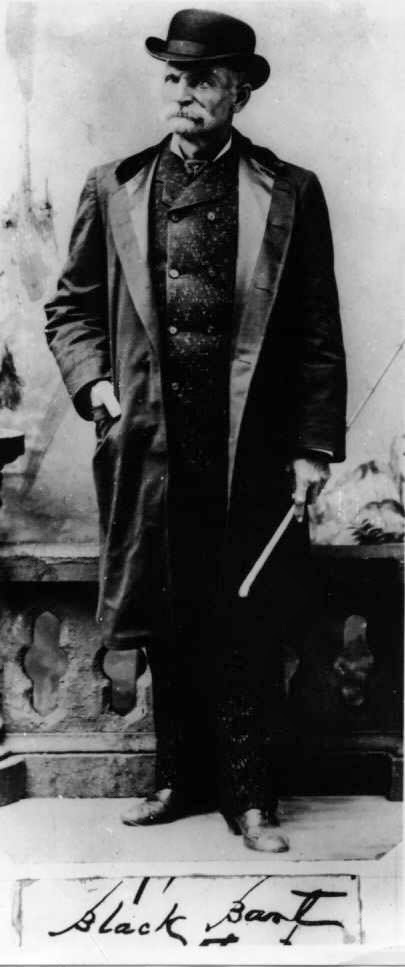
NOVEMBER 3 = "Black Bart" Robs His Last Stage Coach
"I've labored long and hard for bread
for honor and for riches
But on my corns too long youve tred
You fine haired sons of Bitches"
- Charles E. "Black Bart" Boles
August 3, 1877
This was one of two verses left at the scene of stage coach robberies by the notorious outlaw known as "Black Bart", a.k.a. the "Gentleman Bandit" or the "Poet-Bandit", who pulled his last heist on this date, November 3, in 1883. Bart may be more accurately called a gentleman than a poet or even a bandit, because he only wrote two poems, and in his long career, he always was very polite, and never robbed a stage coach passenger. Never once did he fire at anyone, although he was fired upon, and he was wounded several times.
Charles Turns Prospector, & Soldier...
There is a great deal about this man which remains shadowy, but it is known that our man, Charles Earl Bowles (or Bolles) was born in Norfolk, England in 1829, though on what date isn't clear. His parents John and Maria Bowles, immigrated to the United States and lived in Jefferson County, New York. Charles evidently had an adventurous nature because in 1849, he left with two of his
brothers in the great Gold Rush of 1849. He made a couple of such trips to California over the next several years during which two of his brothers died. But during this time he grew accustomed to the hard scrabble life of the miners; (above) sleeping on the ground with an ever-present uncertainty of reward. In 1854, Bowles married Mary Elizabeth Johnson of Illinois. They had four children together and by 1860 were living on a farm in Decatur, Illinois. This was Civil War time in America, and Charles, with his love of adventure and hard living enlisted in the Union Army - the 116th Illinois Regiment. He was a good soldier, being wounded several times and taking part in the siege of Vicksburg, and Sherman's March to the Sea. By the time he left the army in 1865, he had risen to the rank of Sergeant.
And Then Turns Bandit...
But after the war, a return to the rooted life of farming was impossible to a man like Charles Bowles with his love of adventure. So he returned to prospecting in Idaho and Montana, abandoning his wife and four children. Mary got letters from him for a time, but after they stopped coming she assumed he had died. But in one letter in August of 1871, he mentioned having trouble with the authorities of Wells Fargo Bank, and vowed to get back what was his: "I am going to take steps." On July 26, 1875 the Wells Fargo stage coach from Sonora to Milton in Calveras County, California was robbed by a man in a long duster-style coat, and wearing a potato sack over his head with two holes cut in it for his eyes. Atop his head he wore a Bowler hat. His voice was said to have been
strong and sonorous, saying only "Please throw down the box." to the driver, one John Shine. This of course referred to the Wells Fargo Strong Box (right) which made the stage coaches such an inviting target. As he took the strong box, he yelled "If he dares to shoot give him a solid volley, boys!" Shine looked around himself and saw several rifles barrels aiming at him from the surrounding bushes. The bandit then plundered the box of it's contents: $160.00 in cash, and walked away. Upon examination, Shine found that the rifle barrels surrounding him were in fact painted and carefully rigged... sticks!! This robbery featured several points which became trademarks of this bandit: he always wore the same garb, was always very polite, eschewing any profanity, he always worked alone, and always made his way on foot, never on horseback.
And Then Turns Poet....
Over the next nine years, the same assailant would commit nearly 30 such robberies in and near the San Francisco Bay area of California. Sometimes he would make off with a lot, and sometimes almost nothing. But it was the note with which this posting began found following a robbery on August 3, 1877, that he acquired his nickname and the label of the "Poet Bandit", as he signed the verse "Black Bart, the PO 8". The Old West produced a good deal of cheap pulp fiction
about gunfighters and bandits, and our culprit appeared to be a reader of it. A serialized version of a story about a robber of stages was published in the Sacramento Union in the early 1870's. The main character in this series was a bandit who was called "Black Bart", so it is assumed that this bandit got the name from that series, after his crimes began making headlines, with the Wells Fargo company leading the charge. Following a robbery on July 25, 1878, he left behind the following cheeky little verse:
- "here I lay me down to sleep
to wait the coming morrow
perhaps success perhaps defeat
and everlasting Sorrow
let come what will I'll try it on
My condition can't be worse
and if theres money in that box
Tis munny in my purse
Black Bart
the PO 8"
And Finally Captive.
It was on today's date in 1883 when Bart was stopped, but not until some modern-style detective work by Wells Fargo Detective James B. Hume. Bart tried to hold up the stage coach on the same road as his first holdup. Reason McConnell was the stage driver who picked up Jimmy Roleri for a ride on the stage. Roleri then left the stage to do some hunting. Roleri returned to the stage just as Bart was attempting to hold it up. Bart fled as soon as he saw Roleri with his rifle, with McConnell and Roleri getting off shots at him, and one of them hitting him in the hand. When Detective Hume examined the scene of the crime later, he found Bart's hat, a lunch he had prepared and a bloody handkerchief which had the marking "F.X.O.7". At a time when justice was largely a matter of posses and lynching, Hume decided to attempt following this lead
in tracking down the owner of the handkerchief by using this odd marking. So he visited every laundry in San Francisco, and after he get through 90 such, he found the one that recognized the marking and was able to ID the customer who was behind it. It was a very dapper man according to the laundry employees, a "Mr. Charles E. Bolton" who was a respectable gentleman in the mining business. Hume was able to track "Bolton" to his address and after questioning, "Bolton" then admitted to being behind at least some of the robberies. And among his possessions was a Bible from his wife inscribed with his real name: Charles E. Bowles (above, circa 1888). Still even upon being caught he kept up his gentlemanly demeanor. Hume wrote in his notes: "A person of great endurance. Exhibited genuine wit under most trying circumstances. Extremely proper and polite in behaviour, eschews profanity."
Bowles was sentenced to six years in prison, but got out after serving only four, for good behavior. Upon his release reporters asked him if he would continue robbing and he said no, he was through with crime. Asked if he would write anymore poetry, he smiled and said, "Now didn't you hear me say that I am through with crime?" He never did return to his wife. He wrote to her though, saying that he was weary of being shadowed by Wells Fargo agents. He left his hotel on February 28, 1888 and was never seen again. At least not until he appeared in one of the fantasy scenes in 1983's "A Christmas Story" when he was successfully brought in by "Ralphie" and his trusty "Red Ryder B-B Gun".
Sources:
http://en.wikipedia.org/wiki/Black_Bart_(outlaw)
http://www.sptddog.com/sotp/bbpo8.html
http://www.sfmuseum.net/hist9/blackbart.html
http://www.achristmasstoryhouse.com/index.php/a-christmas-story-movie-facts/black-bart/
Subscribe to:
Posts (Atom)