Saturday, November 9, 2013

NOVEMBER 9 = Einstein's Brain....


{The above image can be enlarged somewhat by clicking on the picture}

Albert Einstein was without a doubt one of the most brilliant men who ever lived. But his brain was obviously somewhere in another universe!  Certainly his contributions to the field of theoretical physics are beyond measure - indeed they are the stuff of legend. His special and general theories of relativity, his founding of relativistic cosmology, his prediction of the deflection of light by gravity, and his 1921 Nobel Prize in Physics for his discovery of the law of the photoelectric effect are all accomplishments that contribute to his citation by many as the father of modern physics. But he was a man of humor, a lover of music, and a very gentle man. In fact he was a pacifist. A man possessed of brilliant intellect, and remarkable powers of perception. Nevertheless, he was a typical scientist - while he definitely had very strongly held beliefs on war versus peace, and science and it's place in the modern world, he still had his head firmly in his books and his theories. And not surprisingly, when his world was catching fire around him, while his country of Germany was being swallowed by the conflagration of World War One and its disastrous aftermath he seems to have barely even noticed.

World War One Tears the World Apart


World War One, as will shortly be discussed, was a huge tear in the fabric of civilization as the world had come to know it. Its effects were particularly bad on Germany. Although Einstein had spent much of his early adult life in Switzerland where he worked at the Swiss Patent Office, he had in fact been born in the Kingdom of Wurttemberg, part of the German Empire. And he spent the years of World War One inside Germany. By November of 1918, the tide had clearly turned against the German Empire. Despite having forced the Russians out of the war a year earlier, the Declaration of War by America against Germany and her Allies in April of 1917 had clearly put the momentum behind the Allied cause. The nations of France and England, who had been nearly exhausted by more than four years of continuous bloody warfare now joined with America, and they were closing in on Germany itself. The officers of the German General Staff, seeing that the territorial integrity of Germany was being threatened convinced the Kaiser, Wilhelm II, who by that time had been reduced to a mere figurehead anyway that he would have to abdicate. He did so on November 9 of 1918.

Einstein Seems to Barely Notice All of the Fuss.......


There was great agitation on the campuses of Germany with soldiers and workers councils advocating radical change. This was very evident on the Campus of the University of Berlin wherein Einstein was scheduled to lecture on relativity. Later on in that very week, he would meet with the head of Germany's interim government to effect the release of several of the University professors who had been detained by revolutionary students. He would go on to declare before before a crowd of over one thousand people that "all true democrats must stand guard lest the old class tyranny of the right be replaced by a class tyranny of the left". But on that particular day, Nov. 9 , with the world turned upside down and the University closed, he took little apparent notice of all of the turmoil. Quite laconically in his lecture notes (visible on the above image, about half-way down on the left hand column next to where he has wrtten "9 XI"), amongst all of his mathematical equations he wrote "fiel aus wegen revolution." Classes had been "cancelled due to revolution."


READERS!! If you would like to comment on this, or any "Today in History" posting, I would love to hear from you!!  You can either sign up to be a member of this blog and post a comment in the space provided below, or you can simply e-mail me directly at:  krustybassist@gmail.com  I seem to be getting hits on this site all over the world, so please do write and let me know how you like what I'm writing (or not!)!!

Sources:

Albert Einstein: Creator and Rebel by Banesh Hoffman.
Penguin Books Inc., New York, 1972 pp. 135 - 137.

http://media.caltech.edu/press_releases/12272

http://www.alberteinstein.info/gallery/images/03-009p04lrz.jpg

http://en.wikipedia.org/wiki/Einstein

+ 219.
+ 114.

Wednesday, November 6, 2013

NOVEMBER 6 = Modell's Sucker Punch


Art Modell, 1925 - 2012.

"The evil that men do lives after them.
The good is oft interred with their bones.
So let it be with Caeser."

- "Julius Caeser" Act III, Scene Two
   by William Shakespeare

"We are not moving to Baltimore. In fact, we are trying to move back to Cleveland", says Cleveland Brown, a Cleveland native whose father, grandfather and great-grandfather were also named Cleveland Brown, and whose 13-year-old son is named Cleveland Brown as well. The 38-year-old nuclear medicine technician now lives in Middletown, Ohio. "And no," he says, "my son and I are not changing our names to Baltimore Browns, though I get asked that 14 times a day.....I'm not much of a football fan," says Brown, "but when the Browns said they were moving, it really affected me. Not because of my name, but because for 50 years support for that team by the people has been phenomenal." And that, of course, is what makes this particular move so extraordinary. And so extraordinarily sad."
- Steve Rushin in "Sports Illustrated", Dec. 4, 1995.

It was a black day in the fine city of Cleveland on that date - November 6, 1995. And surely it was one of the darkest days in the Hall of Shame for pro sports. For this was the day on which Art Modell, the owner of one of the proudest, and finest franchises in the history of the National Football League (NFL) announced that he was packing up "his" team and leaving the fans who had so loyally supported their team for 50 years. Never mind the fans who had grown up with the team. Never mind that this was one city which clearly and unequivocally had shown their support for this team for year after year. And some of those years had been pretty lean. No, Mr. Modell had gotten a better deal elsewhere, and he was leaving.

Modell's Double Dealing
Modell claimed that the financial situation in which he found the Browns left him no choice but to move his team. He pointed out that the Browns were $40 million in debt and that he personally had loaned the team $10 million. How could this be? How could a team that had sold 80% or better capacity of it's seats all but four times between '76 and '94(selling 89% or better in eleven of those years including ALL of years from '88 onward) be in such a state of indebtedness? The answer to that was in Modell's own blown financial dealings. Modell bought 51% of the team in 1961. In 1973, seeing that the city of Cleveland was losing money on its operation of Cleveland Stadium, he signed a 25 year lease of the stadium with the city, which gave him the rights to rent the stadium to both the Browns and the Indians - Cleveland's pro baseball franchise. In return, he would receive all the revenue that the stadium would generate including signage, parking and concession sales. In return, he would pay $150,000 per year for the first five years of the deal, and $200,000 thereafter. This was such an excellent deal for himself Modell thought, that he formed a separate stadium company, which he kept mostly for himself, and not for his partners in operating for the Browns.


Modell's Double Dealing Starts to Come Home to Roost

But when he woke up, and found himself operating a 43 year-old stadium with many structural problems, the deal proved to be not so excellent. Structural beams that had eroded with age threw a monkey-wrench into Modell's plans to install luxury boxes, new locker rooms for the visiting teams, new restrooms and a big new modern scoreboard. He had to borrow $10 million just to fulfill these commitments to begin with. With the Indians drawing so poorly at that time, debts to the team, AND to Modell's private stadium company began to snowball. He then tried to sell his fellow operators of the Browns on buying the stadium from him. This would have produced $4.8 million for Modell, and relieved him of his debt while transferring the debt to the Browns. But that deal was squelched by by Robert Gries, who owning 43% of the Browns didn't like the idea of their being saddled with Modell's debt. Modell it turned out, had purchased property in Strongsville, Ohio upon which he had hoped to build a new stadium, and which he had greatly overvalued. This would have been a part of the stadium company which Modell proposed to sell to the Browns. It took four years, but Gries prevailed in court.

Modell to Cleveland: "I'm Outta Here!!"

So, as a result of Modell's faulty business judgement, the city of Cleveland was deprived of it's team and a considerable portion of it's heart on this dark day back in '95. Nevermind that the voters of the city had approved the funds to build a new stadium, just a short time from this whole wretched business. Baltimore offered more monetary sweetness, and Modell just booked. But there is a happy ending - the city of Cleveland was given an NFL expansion franchise in 1999, and retained the use of the Browns name and logos. It has been an uphill climb for the Browns, and continues to be to this day. But this writer, a life-long Bengals fan is very pleased to see them reoccupying their rightful and cherished place in the NFL, and looks forward to a renewal of their rivalry. And the best of all parts of the happy ending: Art Modell never again set foot in Cleveland.

EPILOGUE:

The Baltimore Ravens managed to prosper on the football field, winning Superbowl XXXV following the 2000 NFL season after which Modell handed day to day operations over to his son David.  But Modell just couldn't make ends meet.  So he was obliged by the NFL to sell the franchise in 2003. He died of natural causes on June 6, 2012.  And on that point, I shall leave the last word to Marc Antony whom I quoted via the Bard at the beginning of this posting.


READERS!! If you would like to comment on this, or any "Today in History" posting, I would love to hear from you!!  You can either sign up to be a member of this blog and post a comment in the space provided below, or you can simply e-mail me directly at:  krustybassist@gmail.com  I seem to be getting hits on this site all over the world, so please do write and let me know how you like what I'm writing (or not!)!!

Sources:
http://en.wikipedia.org/?title=Cleveland_Browns#1991.E2.80.931995:_Bill_Belichick_and_Modell.27s

http://en.wikipedia.org/wiki/Art_Modell

"The Heart of a City" by Steve Rushin, "Sports Illustrated" Dec. 5, 1995.


by William Shakespeare, London, England, @ 1599.

+ 75.
+ 86.

Tuesday, November 5, 2013

NOVEMBER 5 = Election DAAAZE!!!

Well I feel that I would be terribly remiss in my duty as an historian if I  were to completely ignore the fact that this is that election time of year!  I will just give a brief little run-down of three races that happened on today's date, November 5 in the past, to remember as you leave the voting booth for another year or two....

1872 = Ulysses S. Grant -VS- Horace Greeley

In 1872, the Republicans re-nominated President Ulysses S. Grant for President.  Grant's administration had been plagued by charges of corruption, and many of these charges were true although Grant himself was an honest man.  The decisiveness that served him so well as the commanding general of the Army of the Potomac during the Civil War deserted him in his Presidency, as he appointed many men who were incompetent, or crooked, and then stood by them for too long.  But still he was very popular as the man who defeated the Confederacy.  His opponent was the celebrated journalist and U.S. Representative from New York, Horace Greeley.  Greeley (below) is described thus by
writer Paul J. Boller Jr.: "Greeley, for all his intelligence, sincerity, idealism, and journalistic aplomb, was erratic, crotchety, unpredictable, and thoroughly incompetent in the art of politics."  On election day, today's date in 1872, at which time my great grandmother, Sarona Cooper, whom we called "Mimma" was two years old, the famous suffragette, Susan B. Anthony took the liberty of voting, for which offense she was arrested on November 18.  She would be fined $100.00. "I will never pay a dollar of your unjust penalty." she said.  She never did.  The government dropped the case.  Women were given the right to vote in 1920, an activity in which my great grandmother would take quite an interest.  Grant wound up easily winning the election with nearly 56% of the popular vote. Greeley died on November 29 of that same year, well after the election, but before the Electoral College met.  Therefore, Greeley's rivals on his side took the liberty of dividing his electoral votes among themselves, making Greeley's posthumous defeat even worse.

1912 = Woodrow Wilson -vs- Theodore Roosevelt & President W.H. Taft

This election was a huge win for the Democratic Nominee, New Jersey Governor, and former Princeton University President Woodrow Wilson. This was mainly because of a rancorous split in the Republican party.  William Howard Taft, was elected President in 1908 with the blessing and support of his predecessor, the irrepressible Theodore Roosevelt.  T.R. could easily have been re-elected himself that year, but the two-term tradition of
U.S. Presidents was established, and he rashly promised early in his second term to respect that tradition.  In those days, a promise was a promise, so T.R. gave way to his old friend, the jolly and rotund William Howard Taft.  But T.R. had been a burr under the saddle of the Republican establishment with his reforming, progressive policies, so they were only too happy to be rid of him. And when Taft proved to be too accommodating to the establishment, T.R. publicly broke with his (former) friend and tried to unseat him by running for the
Republican nomination himself. When the party bosses clamped down and denied him the nomination, T.R. bolted the party, and accepted the nomination of the Progressive Party.  Needless to say, this split in the G.O.P. gave the election on today's date in 1912 to Wilson, who tallied 41.8% of the vote to 27.4% for Roosevelt. Poor Taft came in a distant third with 23.2%.  It was a terrible defeat for T.R. who never again regained the Presidency which he had so loved.  The Progressive Party had been nick-named  
the "Bull Moose" Party in honor of T.R.'s hard-driving image.  After the election a cartoon showing a large, exhausted, and cracked egg with the face of Roosevelt was published along with the taunting rhyme: "Humpty Dumpty sat on the wall/ Humpty Dumpty had a bad fall/ All the ex-bosses/ And Bully Moose Men/ Can never put Humpty up again."
"Click" on the image to enlarge.

1940 = Franklin D. Roosevelt -vs- Wendell Willkie

In 1940, the whole world seemed to be catching fire around an America which up to that point had been desperately trying to stay out of the war in Europe.  But by election day of that year, today's date, most of Europe had been overrun by the forces of Adolf Hitler's Nazis. The Battle of Britain was in full swing as Hitler's air forces tried to bomb England into submission.  The democratic nominee, President Franklin D. Roosevelt who had already served two terms was breaking a two-term tradition in a way that his relative, Theodore Roosevelt (who was the Uncle of FDR's wife, Elanor) had been unable to try.  FDR said that with the world closing in on the U.S. like it was in a way that would probably involve America, it was his duty to stay on.   His opponent was a maverick businessman (ala Donald Trump??) named Wendell Willkie (below) who managed to outmaneuver Senator Robert A. Taft (the son of William Howard Taft)
and New York Governor Thomas Dewey and pick up the Republican nomination.  Although Willkie was nearly identical to FDR in his attitude towards the war raging in Europe, Republicans damned Roosevelt for his economic policies. My great grandmother who was now an active Republican stalwart (now you know where I get it!) ran, I am told, one of those homes wherein the very mention of the word "Roosevelt" would get the speaker soap in his mouth.  And this was what Willkie attacked Roosevelt for.  But it didn't work.  FDR carried 54.8% of the popular vote that year, gaining that unprecedented third term. My great grandmother lived until she was 99, passing away in 1969 when I was nine years old.  Franklin Roosevelt would be elected to a fourth term in 1944, before succumbing to a stroke in April of 1945.  Wendell Willkie would die in 1944.  But one small fragment of his spirited 1940 campaign has survived.  It is the "1940 Psalm" which sarcastically sums up how the opposition felt about FDR's economic policies:

"Mr. Roosevelt is my Shepherd, I am in want.
He maketh me lie down on park benches
He leadeth me beside still factories.
He leadeth me in the path of destruction for the New Deal's sake.
Yea, tho I walk through the valley of depression, I anticipate no recovery, for he is with me.
His policies and diplomacies they frighten me.
He prepareth a reduction in my salary.
And in the presence of my enemies, he anointed my small income with taxes.
My expenses runneth over.
Truly unemployment shall follow all the days of my life.
And I shall live in a mortgaged home for ever".

Sources:

"Presidential Campaigns" by Paul F. Boller Jr., Oxford University Press, New York, 1984

"The Life and Times of Teddy Roosevelt" by Stefan Lorant, Doubleday & Co., Garden City, N.Y., 1959

+ 66.

Monday, November 4, 2013

NOVEMBER 4 = "CATS" Author Wins Nobel Prize


"I have a Gumbie Cat in mind.
Her name is Jennyanydots.
Her coat is of the tabby kind with tiger stripes and leopard spots.
All day she sits beneath the stairs or on the steps or on the mat.
She sits and sits and sits and that's what makes a gumbie cat."

- from "Old Possums Book of Practical Cats", by T.S. Eliot.

On today's date, November 4 in 1948, T.S. (Thomas Stearns) Eliot was awarded the Nobel Prize for Literature for the exceptional contribution that he had made to the world of poetry in the 20'th Century. Eliot was a man of extraordinary literary gifts, and even though he did not consider himself to be a terribly prolific writer, his effect on the direction of poetic verse in the 20'th Century was profound. But it was as the author of the above quoted and pictured book of verses that his work came to the ears of the late 20'th Century reader, and Broadway Music lover (although I'm not at all certain that most people are aware of that fact), and it was almost how he came to MY eyes.


The Life and Work of T.S. Eliot

Eliot was born in St. Louis, Missouri, to a prominent family. His grandfather, his father, and his mother were all leading citizens in the cultural and business world of St. Louis. Eliot took an undergraduate degree at Harvard, studied at the Sorbonne, returned to Harvard to learn Sanskrit, and then studied at Oxford. He became lifelong friends with fellow poet Ezra Pound and later moved permanently to England. In 1915, he married Vivian Haigh-Wood, but the marriage was unhappy, partly due to her mental instability, and partly because Eliot suspected that she had had an affair with the philosopher Bertrand Russell. Writing privately in his sixties, Eliot confessed:

"I came to persuade myself that I was in love with Vivienne simply because I wanted to burn my boats and commit myself to staying in England. And she persuaded herself (also under the influence of [Ezra] Pound) that she would save the poet by keeping him in England. To her, the marriage brought no happiness. To me, it brought the state of mind out of which came 'The Waste Land'."

Eliot began working at Lloyd's Bank in 1917, writing reviews and essays on the side. He founded a critical quarterly, Criterion, and quietly developed a new style of poetry. His first major work, "The Love Song of J. Alfred Prufrock", was published in 1917 and hailed as the invention of a new kind of poetry. His long, fragmented images and use of blank verse influenced nearly all future poets, as did his masterpiece "The Waste Land", published in 1922. While Eliot is best known for revolutionizing modern poetry, his literary criticism and plays were successful as well, his play, "the Cocktail Party" for example being produced on Broadway and winning the 1950 Tony Award for Best Play of the Year. Eliot had indeed become a British citizen though, having been granted that status in 1927. On January 10, 1957, Eliot at the age of 68 married Esmé Valerie Fletcher, who was 32. In contrast to his first marriage, Eliot knew Fletcher well, as she had been his secretary at Faber since August 1949. But he had been a heavy smoker all of his life, and this eventually took him. Eliot died of emphysema in London on January 4, 1965.

"Old Possum's Book of Practical Cats"

In 1930, Eliot published a book of light, almost child-like verses. Taking Ezra Pound's nickname for himself, Eliot titled the book "Old Possum's Book of Practical Cats" In 1954, the composer Alan Rawsthorne set six of the poems for speaker and orchestra, in a work entitled "Practical Cats". After Eliot's death, the book was adapted as the basis of the musical, "Cats", by Andrew Lloyd Webber, first produced in London's West End in 1981 and opening on Broadway the following year. "Cats" became the second longest-running show in Broadway history (running until 2000), and the fourth longest-running West End musical. It has been performed around the world many times and has been translated into more than 20 languages.

It was in this way, I think, that I became familiar with the work of Eliot. I was at the home of one of my high school friends, Glenn Pepple. I had been there with our mutual friend, the artist Jon Jay Muth, and we were both having a look at a few of Glenn's books. We ran across a collection of poems by this man, T.S. Eliot, of whom I had never heard before. Whether Glenn had purchased the book in reaction to the fame of "Cats", I don't know. But I found the Cat poems in the book and began reading some of them to Jay. I don't recall whether or not Jay was already familiar with them, but they were quite new to me. I was instantly captivated by these charming verses, and have remained so ever since (which is odd, since I have always been a dog owner). My favorite poem was always "Growltigers Last Stand". But the poems "Rum Tum Tugger" and "Jellicles" were also much enjoyed by me and the countless people to whom I've presented this fun collection as a gift over the years.  And of course there is "The Old Gumbie Cat":                                                                 

"I have a Gumbie Cat in mind, her name is Jennyanydots;
Her coat is of the tabby kind, with tiger stripes and leopard 

spots.
All day she sits upon the stair or on the steps or on the mat;
She sits and sits and sits and sits--and that's what makes a 

Gumbie Cat!

But when the day's hustle and bustle is done,
Then the Gumbie Cat's work is but hardly begun.
And when all the family's in bed and asleep,
She tucks up her skirts to the basement to creep.
She is deeply concerned with the ways of the mice
Their behaviour's not good and their manners not nice;
So when she has got them lined up on the matting,
She teachs them music, crocheting and tatting.

I have a Gumbie Cat in mind, her name is Jennyanydots;
Her equal would be hard to find, she likes the warm and sunny spots.
All day she sits beside the hearth or on the bed or on my hat:
She sits and sits and sits and sits--and that's what makes a Gumbie Cat!

But when the day's hustle and bustle is done,
Then the Gumbie Cat's work is but hardly begun.
As she finds that the mice will not ever keep quiet,
She is sure it is due to irregular diet;
And believing that nothing is done without trying,
She sets right to work with her baking and frying.
She makes them a mouse--cake of bread and dried peas,
And a beautiful fry of lean bacon and cheese.

I have a Gumbie Cat in mind, her name is Jennyanydots;
The curtain-cord she likes to wind, and tie it into sailor-knots.
She sits upon the window-sill, or anything that's smooth and flat:
She sits and sits and sits and sits--and that's what makes a Gumbie Cat!

But when the day's hustle and bustle is done,
Then the Gumbie Cat's work is but hardly begun.
She thinks that the cockroaches just need employment
To prevent them from idle and wanton destroyment.
So she's formed, from that lot of disorderly louts,
A troop of well-disciplined helpful boy-scouts,
With a purpose in life and a good deed to do
And she's even created a Beetles' Tattoo.

So for Old Gumbie Cats let us now give three cheers
On whom well-ordered households depend, it appears."


READERS!! If you would like to comment on this, or any "Today in History" posting, I would love to hear from you!! You can either sign up to be a member of this blog and post a comment in the space provided below, or you can simply e-mail me directly at: krustybassist@gmail.com I seem to be getting hits on this site all over the world, so please do write and let me know how you like what I'm writing (or not!)!!


Sources:


by T.S. Eliot, London, 1939.


http://www.angelfire.com/mi/JellicleBall/Gumby.html

http://en.wikipedia.org/wiki/T._S._Eliot

http://en.wikipedia.org/wiki/Cats_(musical)

+ 121.
+ 218.

Sunday, November 3, 2013

NOVEMBER 3 = "Black Bart" Robs His Last Stage Coach


"I've labored long and hard for bread
 for honor and for riches
 But on my corns too long youve tred
 You fine haired sons of Bitches"

- Charles E. "Black Bart" Boles
   August 3, 1877

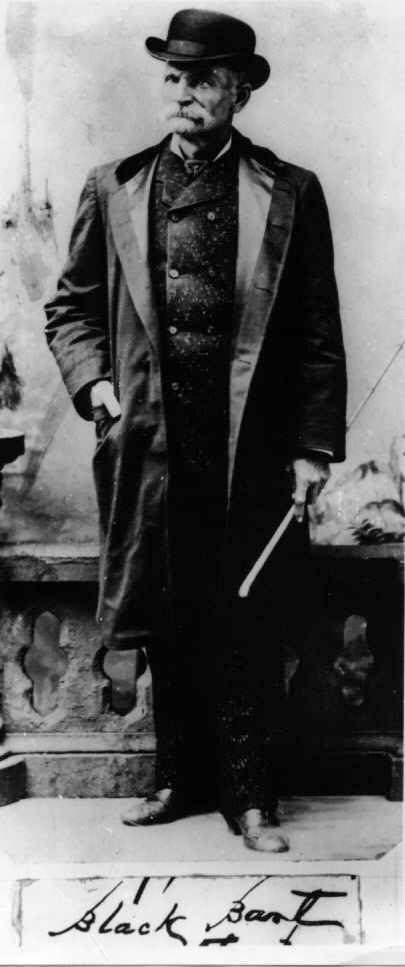
This was one of two verses left at the scene of stage coach robberies by the notorious outlaw known as "Black Bart", a.k.a. the "Gentleman Bandit" or the "Poet-Bandit", who pulled his last heist on this date, November 3, in 1883.  Bart may be more accurately called a gentleman than a poet or even a bandit, because he only wrote two poems, and in his long career, he always was very polite, and never robbed a stage coach passenger. Never once did he fire at anyone, although he was fired upon, and he was wounded several times.

Charles Turns Prospector, & Soldier...

There is a great deal about this man which remains shadowy, but it is known that our man, Charles Earl Bowles (or Bolles) was born in Norfolk, England in 1829, though on what date isn't clear. His parents John and Maria Bowles, immigrated to the United States and lived in Jefferson County, New York. Charles evidently had an adventurous nature because in 1849, he left with two of his
brothers in the great Gold Rush of 1849. He made a couple of such trips to California over the next several years during which two of his brothers died. But during this time he grew accustomed to the hard scrabble life of the miners; (above) sleeping on the ground with an ever-present uncertainty of reward. In 1854, Bowles married Mary Elizabeth Johnson of Illinois. They had four children together and by 1860 were living on a farm in Decatur, Illinois. This was Civil War time in America, and Charles, with his love of adventure and hard living enlisted in the Union Army - the 116th Illinois Regiment.  He was a good soldier, being wounded several times and taking part in the siege of Vicksburg, and Sherman's March to the Sea. By the time he left the army in 1865, he had risen to the rank of Sergeant.

And Then Turns Bandit...

But after the war, a return to the rooted life of farming was impossible to a man like Charles Bowles with his love of adventure.  So he returned to prospecting in Idaho and Montana, abandoning his wife and four children.  Mary got letters from him for a time, but after they stopped coming she assumed he had died.  But in one letter in August of 1871, he mentioned having trouble with the authorities of Wells Fargo Bank, and vowed to get back what was his: "I am going to take steps."  On July 26, 1875 the Wells Fargo stage coach from Sonora to Milton in Calveras County, California was robbed by a man in a long duster-style coat, and wearing a potato sack over his head with two holes cut in it for his eyes. Atop his head he wore a Bowler hat.  His voice was said to have been
strong and sonorous, saying only "Please throw down the box." to the driver, one John Shine.  This of course referred to the Wells Fargo Strong Box (right) which made the stage coaches such an inviting target. As he took the strong box, he yelled "If he dares to shoot give him a solid volley, boys!" Shine looked around himself and saw several rifles barrels aiming at him from the surrounding bushes.  The bandit then plundered the box of it's contents: $160.00 in cash, and walked away.  Upon examination, Shine found that the rifle barrels surrounding him were in fact painted and carefully rigged... sticks!!  This robbery featured several points which became trademarks of this bandit: he always wore the same garb, was always very polite, eschewing any profanity, he always worked alone, and always made his way on foot, never on horseback.

And Then Turns Poet....

Over the next nine years, the same assailant would commit nearly 30 such robberies in and near the San Francisco Bay area of California.  Sometimes he would make off with a lot, and sometimes almost nothing.  But it was the note with which this posting began found following a robbery on August 3, 1877, that he acquired his nickname and the label of the "Poet Bandit", as he signed the verse "Black Bart, the PO 8".  The Old West produced a good deal of cheap pulp fiction
about gunfighters and bandits, and our culprit appeared to be a reader of it.  A serialized version of a story about a robber of stages was published in the Sacramento Union in the early 1870's. The main character in this series was a bandit who was called "Black Bart", so it is assumed that this bandit got the name from that series, after his crimes began making headlines, with the Wells Fargo company leading the charge.  Following a robbery on July 25, 1878, he left behind the following cheeky little verse:
    "here I lay me down to sleep
    to wait the coming morrow
    perhaps success perhaps defeat
    and everlasting Sorrow
    let come what will I'll try it on
    My condition can't be worse
    and if theres money in that box
    Tis munny in my purse
    Black Bart
    the PO 8"
And Finally Captive.

It was on today's date in 1883 when Bart was stopped, but not until some modern-style detective work by Wells Fargo Detective James B. Hume.  Bart tried to hold up the stage coach on the same road as his first holdup.  Reason McConnell was the stage driver who picked up Jimmy Roleri for a ride on the stage. Roleri then left the stage to do some hunting.  Roleri returned to the stage just as Bart was attempting to hold it up.  Bart fled as soon as he saw Roleri with his rifle, with McConnell and Roleri getting off shots at him, and one of them hitting him in the hand.  When Detective Hume examined the scene of the crime later, he found Bart's hat, a lunch he had prepared and a bloody handkerchief which had the marking "F.X.O.7".  At a time when justice was largely a matter of posses and lynching, Hume decided to attempt following this lead
in tracking down the owner of the handkerchief by using this odd marking. So he visited every laundry in San Francisco, and after he get through 90 such, he found the one that recognized the marking and was able to ID the customer who was behind it.  It was a very dapper man according to the laundry employees, a "Mr. Charles E. Bolton" who was a respectable gentleman in the mining business. Hume was able to track "Bolton" to his address and after questioning,  "Bolton" then admitted to being behind at least some of the robberies.  And among his possessions was a Bible from his wife inscribed with his real name: Charles E. Bowles (above, circa 1888).  Still even upon being caught he kept up his gentlemanly demeanor.  Hume wrote in his notes: "A person of great endurance. Exhibited genuine wit under most trying circumstances. Extremely proper and polite in behaviour, eschews profanity."  

Bowles was sentenced to six years in prison, but got out after serving only four, for good behavior. Upon his release reporters asked him if he would continue robbing and he said no, he was through with crime.  Asked if he would write anymore poetry, he smiled and said, "Now didn't you hear me say that I am through with crime?" He never did return to his wife.  He wrote to her though, saying that he was weary of being shadowed by Wells Fargo agents.  He left his hotel on February 28, 1888 and was never seen again. At least not until he appeared in one of the fantasy scenes in 1983's "A Christmas Story" when he was successfully brought in by "Ralphie" and his trusty "Red Ryder B-B Gun".


Sources:

http://en.wikipedia.org/wiki/Black_Bart_(outlaw)

http://www.sptddog.com/sotp/bbpo8.html

http://www.sfmuseum.net/hist9/blackbart.html

http://www.achristmasstoryhouse.com/index.php/a-christmas-story-movie-facts/black-bart/


Thursday, October 31, 2013

OCTOBER 31 = Harry Houdini Dies


"Don't insult me by calling me a magician, I'm an escape artist!"
- Harry Houdini

How very appropriate for Halloween that it should have been the day on which the world lost one of the most extraordinary escape artists, magicians, and debunkers of fake mediums of all time - the incredible Harry Houdini. For it was on this date in 1926 that this remarkable man left us. Born Erich Weiss in 1874 in Budapest Hungary, Houdini was the son of a rabbi who failed to get tenure, and an adoring mother, whom he adored in return. His family emigrated to the United States in 1878, and took up residence in Appleton, Wisconsin. He was called "Harry" by his friends and family, and later took the show name of "Houdini" from Jean Eugène Robert-Houdin, a magician whom he greatly admired.

Houdini's Early Career

Houdini was a man of many psychological anxieties and conflicts - these were reflected in his work which had elements of exhibitionism, entrapment, and a bizarre courting of death. First focusing on ordinary card tricks, Houdini started out by performing at dime museums and side shows. In 1893, he met Wilhelmina Beatrice "Bess" Rahner whom he married and with whom he shared a devoted love for the rest of his life. Indeed, she would serve as his onstage assistant throughout his career. He soon began experimenting with escape acts, and in 1899, he met Martin Beck who, upon seeing Houdini's handcuff act was sufficently impressed that he told Houdini that he should concentrate on his escape tricks. Beck became Houdini's manager and booked him on Vaudeville's "Orpheum Circuit". Soon Houdini was performing at the biggest shows in the country. His acts were amazing feats of escape skill. in 1906 or example, he went to the Boston Police Department,
took off all of his clothes, and demanded a full body search to make it clear that he wasn't hiding any keys on his person. Then with his clothes in a locked cell on another tier, he was shackled, handcuffed and locked in another cell. His only condition was that he be left unobserved. In a mere sixteen minutes, he escaped his irons, recovered his clothes, climbed the prison wall, and drove in a waiting automobile to a theatre from which he telephoned an astonished prison superintendant who thought that Houdini was still very much in his cell.

Houdini's Death Defying Escapes

This use of the sensational idea of being stripped naked was just one of the ways in which this man used all of his skills to provoke and amaze audiences. Using his strong and atheletic physique to its full advantage, he worked his way out of canvas straight jackets, untying knots opening buckles with his teeth, and conserving his breath by never giving way to fear. His bold and audacious aeriel escapes were the stuff of legend. Having himself suspended from newspaper buildings many stories in the air he would be bound in a thick leather and canvas straight jacket. Then while unbelieving crowds of many thousands of spectators watched from the streets below he would violently twist and jerk himself around emerging free of his constraints in a few minutes with his arms outstretched in a victory salute to the cheering crowd to whom he would toss the jacket. A mainstay of his act was introduced in 1912 - his "Chinese Water Torture Cell". The cell was a metal lined
mahogany cabinet, six feet high, and three feet square at its base. The front of the cell was an inch thick plate glass window. He would appear only in a bathing suit, have himself hung upside down and locked inside with his ankles shackled and the cell filled with water. With anxious assistants standing by with axes ready to break the locks in case of an accident, he would be lowered in and a curtain drawn. One, two sometimes three minutes would pass before Houdini would then thrust the curtain aside and stride forward, dripping wet, but quite alive with the empty cell behind him locked as securely as it had been at the start.

Houdini's Life as a Spiritualist and a Spiritualist Debunker

It was with his mother's death in 1913 that he became interested in spiritualism. He was deeply saddened, some would say shattered by the loss of this woman who had been his number one fan and supporter along with his wife throughout his career. He was fascinated by the possibility of immortality that spiritualism seemed to offer, and he craved some proof of it. He spent the rest of his life seeking some spiritual contact with his dear, departed mother. But he was relentless in his drive to disprove and uncover the many fake mediums and spiritualists with which the world abounded. He would wear disguises and attend seances and catch the mediums red-handed, exposing them to public ridicule. His training as a magician afforded him considerable expertise in the art of illusion, and he used this to debunk seances wherein tables would seem to rise, and ghostly voices seem to sound. This lead hin to a very public falling out with Sir Arthur Conan Doyle the author of the "Sherlock Homes" mysteries and an ardent believer in spiritualism.

Houdini's Death in 1926

Houdini was very proud of his athletic build, and was ready to take on nearly any challenge that was presented to him. This, unfortunately lead to his untimely death on today's date in 1926. While on tour with his show in the city of Montreal, some students challenged him to prove his strong build by taking a forceful punch in his abdomen. Houdini was of course more than willing and able to withstand such a blow. However, the student landed the punch before Houdini was quite ready, and he had not been able to flex his abdominal muscles to readiness. This caused him to suffer a ruptured appendix. He was obviously hurt, but Houdini, ever the showman refused to admit to any illness, and insisted on continuing his show tour. He died of peretonitis in a Detroit hospital. Houdini had previously made plans with his beloved wife that if he died, he would deliver some sign to her if his spirit was successfully raised in a seance. For ten years, on Halloween, she would dutifully hold seances on hoping that she could raise his spirit. It never happened, and the sign never came. In 1936, saying ten years was long enough to wait for any man she held one last try, and then gave up. She went to join him, dying in 1943.


READERS!! If you would like to comment on this, or any "Today in History" posting, I would love to hear from you!! You can either sign up to be a member of this blog and post a comment in the space provided below, or you can simply e-mail me directly at: krustybassist@gmail.com I seem to be getting hits on this site all over the world, so please do write and let me know how you like what I'm writing (or not!)!!


Sources =

Gen. Ed., Mark C. Carnes "Houdini" - John F. Kasson, pp. 212 - 215. Henry Holt Inc., New York, 1995.

http://en.wikipedia.org/wiki/Houdini

+ 955.
+ 300.

OCTOBER 31 = HALLOWEEN !!


OK.... well I guess that I have managed to more or less "dance" around the periphery of this rather goofy, yet very fun day for long enough. I've done many postings about Halloween-related things.  But now I shall at long last give you all some background on the day itself and how it came to be, as well as some bits about related icons.

"All Hallows Eve"; 5'th Century BC, Ireland.
Way back during the misty days of Celtic Ireland, this day was indeed a festival for ghosts, witches and the like, but far from being the fun-for-the-kiddies type of thing that it has long since become, in the olllld days it was a deadly serious business for grown-ups. It was called "All Hallows Eve" back then and it was always held on the night of October 31, which was the official end of summer by the Celtic calendar. All throughout good Celtic homes, fires and hearths were extinguished in order to make the places cold and less inviting to the various dis-embodied spirits which were quite seriously believed to be lurking about. And then all of these earnest Celtic homefolks would gather outside the village around a large bonfire which had been kindled by a Druid Priest as a way of thanking the Sun God for the previous season's harvest as well as to frighten away the ill-spirits.

These Ill Spirits, and the Reason for Dressing Up...

It was a Celtic belief that persons who had died during the previous year would gather up and choose the body of some living being to inhabit for
the coming year before they could pass peacefully into the next life. To frighten away these would-be body snatchers, the good Celts would dress themselves up as Witches, Demons and Hobgoblins, and go dancing 'round their villages and through their empty, fireless homes making as much noise as they could, leading to the bonfire outside. ANNND (this is the deadly serious part) any villager who was deemed either by dress or behavior to be already possessed by these spirits and thus could be bundled up and dispatched to the flames as a human sacrifice and as a warning to other spirits who were thinking of taking up residence in a human body.

Romans, Immigrants, and the Conversion 

The Romans adopted many of the Celtic practices during their long occupation of the British Ilses, but in 61 AD human sacrifice was outlawed, so they took up the Egyptian practice of consigning effigies to the flames (various statuette representations of persons who were important in the lives of Pharaohs). In time, as belief in evil spirits waned, many of these various Halloween practices lightened up into ritualized amusements (FUN STUFF!!). The Irish potato famine of the 1840's brought many new Irish immigrants to the United States, and they in turn brought many of their customs with them, including their old custom of Halloween dress-ups and mischief-making.

The "Jack O'- Lantern"

One of these customs became one which New England agricultural practices obliged them to modify into an old tradition of Halloween which is now quite familiar. The ancient Celts had followed a practice of carving out the insides of a large turnip and carving a demons face on it and then lighting the inside with a candle as a part of their spirit scaring ritual. These Irish immigrants found not so many turnips around in New England, but whole fields filled with pumpkins which were more than suitable substitutes.  The term "Jack O'- Lantern"
comes from Irish folk lore. The bit goes that a man named Jack, a notorious lush and a tight-wad to boot, tricked the devil into climbing up a tree, and then carved a cross on the tree's trunk to trap 'ol Satan in the tree wherein presumably he would cease to tempt Jack any more. But upon death Jack, who because of his drinking couldn't get into heaven also found his entrance to hell blocked by an angry Satan begged the old devil for something to light his way through the darkness he was condemned to wonder about in until judgement day. The Devil gave him one little burning ember which Jack put inside one of those hollowed out turnips we mentioned before, in order to keep it going for awhile. Hence the term "Jack 'O-Lantern". This comes rather close to Linus's "Great Pumpkin" bit in my humble opinion, but alas, poor Linus's idea never really caught on. Too bad, that!

"Trick or Treat"

According to Mr. Panati, the most accepted theory for the origin of this most fun part of the Halloween tradition has its roots in the mid-ninth century European custom of "souling". On "All Souls Day", went from one village to the other begging for square-shaped biscuits with currants called "soul-cakes". The beggars would promise to offer up prayers for the donors generosity, the bigger the cake, the bigger the prayers. This was important, because the amount of prayers a person amassed during his life would shorten his stay in limbo before entering heaven. So give me a big prayer cake it's a treat for you, but a small one made it a trick for me to play on you, I believe. So "Trick or Treat" in return for a nice "Snickers" bar is a small price to pay for your immortal soul, yes??FUN!!


Sources =

"Extraordinary Origins of Everyday Things" by Charles Panati; Harper & Row Publ., New York, 1987

+ 44